Setting Up Your Organic Pest Defense: Neem and Diatomaceous Earth in Spring
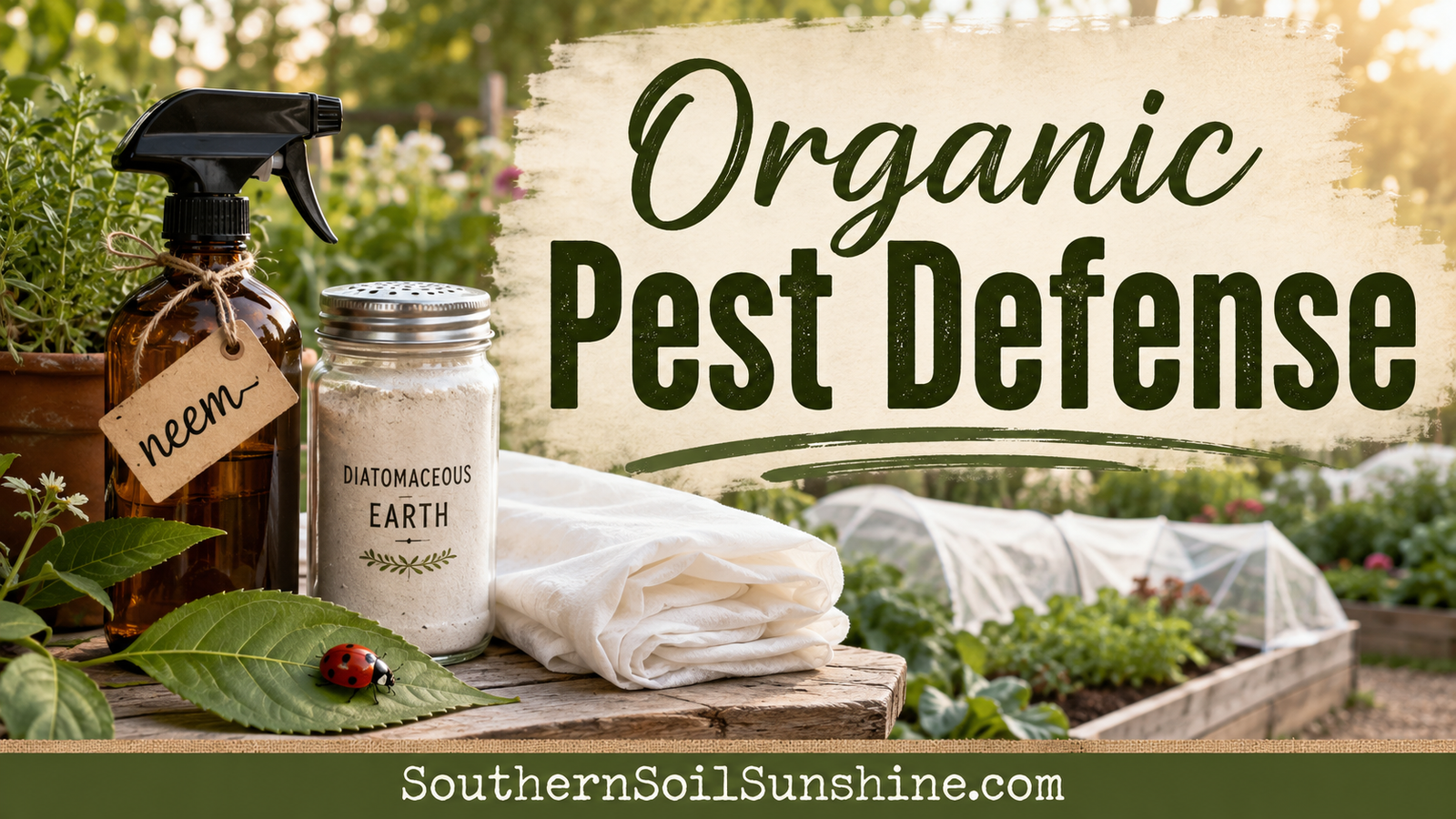
Gentle Tools for the Season Ahead 🌿
As spring warms into its fullness, the pests wake up in earnest. The tender new growth all over your Zone 9 garden is a feast for aphids, caterpillars, beetles, and more, and mid-April is the ideal time to set up your organic pest defense — before problems spread rather than after. Two gentle, natural tools belong in every organic gardener’s kit: neem oil and diatomaceous earth. Used thoughtfully and early, they let you set firm but gentle boundaries against pests without reaching for the harsh chemicals that harm your soil, your beneficial insects, and the very balance that keeps a garden healthy.
This day’s task is to apply organic pest control as needed, and it carries a wise phrase: set gentle boundaries before damage spreads. Let me introduce you to neem and diatomaceous earth — what each does, how and when to use them, and why setting gentle, early boundaries is such a healthy way to protect what you are growing.
Free eBook
Rooted in Grace
A Christian guide to intuitive gardening — the whole book, free. Tell me where to send it and it’s yours in a minute.
Meet Your Two Gentle Defenders
Neem oil and diatomaceous earth work in completely different ways, which is exactly why they make such a good pair. Neem oil, pressed from the seeds of the neem tree, is a natural substance that disrupts the feeding and life cycle of soft-bodied insects like aphids, whiteflies, and mites, and helps deter many others. It also has mild fungicidal properties, useful in our humid climate. Diatomaceous earth, or DE, is a fine powder made from fossilized algae; it works mechanically rather than chemically, its microscopic sharp edges damaging the shells of crawling insects like ants, pill bugs, and slugs so they dehydrate. One is a spray for the plants; the other is a dust for the soil and surfaces. Together they cover a wide range of common garden pests, gently.
| Tool | Best Against | How It Works |
|---|---|---|
| Neem oil (spray) | Aphids, mites, whiteflies, some fungus | Disrupts feeding & life cycle |
| Diatomaceous earth (dust) | Ants, pill bugs, slugs, crawling pests | Damages shells; dehydrates |
How to Use Neem Oil
Neem is applied as a diluted spray. Mix it according to the label with water and a drop of mild soap to help it emulsify, and spray it onto affected plants, being sure to coat the undersides of leaves where pests hide. The keys to using neem well are timing and thoroughness. Spray in the early morning or evening, never in the heat of direct midday sun, which combined with the oil can burn leaves. Coat the plant thoroughly, since neem works on contact and by ingestion. And reapply every week or so while a problem persists, as neem breaks down and does not linger long. Used this way, it gently knocks back soft-bodied pests without the collateral damage of a broad chemical spray.
How to Use Diatomaceous Earth
DE is applied dry, as a dust. Sprinkle a light band of food-grade diatomaceous earth around the base of plants you want to protect, or in the paths where crawling pests travel, creating a barrier they must cross. It works only while dry, so you will need to reapply after rain or heavy dew — a real consideration in our climate. A light dusting is all you need; you are creating a boundary, not burying the plant. DE is especially useful against the pill bugs and slugs that devour tender seedlings, and against ant trails.
Boundaries, Not Warfare
The philosophy behind organic pest defense is worth naming, because it shapes how you use these tools. The goal is not to eliminate every insect — a sterile garden is a dead one — but to keep pests in check so your plants can thrive, while preserving the beneficial insects and healthy balance that do most of your pest control for free. So the organic gardener works gently and in order: encourage beneficial insects and healthy plants first, handpick and spray with water for small problems, and reach for neem or DE only when a specific pest is genuinely threatening to spread. These tools are boundaries you set when needed, not weapons in a war against nature. Set thoughtfully and early, they let you protect your garden while keeping it alive and in balance.
Set Gentle Boundaries Before Damage Spreads
This day’s phrase is one of the wisest the whole calendar offers: set gentle boundaries before damage spreads. It is exactly the right posture toward pests — not panicked overreaction, not passive neglect, but calm, gentle, early boundary-setting that protects what matters before a small problem becomes a large one. You do not wait until the aphids have overrun everything; you set a gentle boundary while the problem is small. And you do not scorch the earth to deal with them; you use the mildest effective means, preserving the good along with removing the harmful.
What a picture this is for the boundaries we are called to set in our own lives. So often we get it wrong in one of two directions: we set no boundaries at all, letting harmful things spread unchecked until they have overrun what we love — or we set them harshly and too late, scorching everything in a reactive overcorrection. The garden models a better, gentler way: boundaries set early, before damage spreads, and set gently, protecting the good while checking the harmful. A gentle boundary, drawn in time, prevents the very damage that a harsh boundary later can only try to repair. So as you set your garden’s gentle defenses today, let it ask you where in your own life a gentle boundary, set now while a problem is still small, might protect what you love before damage spreads. Set the boundaries. Set them early. Set them gently. It is one of the most protective and loving things you can do — in the garden, and everywhere else.
Share your organic pest defense tips with us on Instagram @southernsoils — there is real wisdom in a garden protected gently and in balance.
A Least-Harm Ladder for Pests
The healthiest gardens follow a simple principle: always reach for the gentlest effective response first, and escalate only as needed. Neem and DE sit in the middle of that ladder, not at the top — there is gentler ground below them, and it handles most problems.
| First Try… | Then If Needed… |
|---|---|
| Healthy plants & beneficial insects | Handpicking & a blast of water |
| Handpicking & water | Insecticidal soap on soft pests |
| Soap | Targeted neem oil or DE barriers |
| Neem / DE | Row covers, traps, hand-removal of the source |
Notice that harsh chemical pesticides do not appear on this ladder at all — and in an organic garden, they need not. By the time you have worked through healthy plants, beneficial insects, handpicking, water, soap, and targeted neem or DE, the vast majority of pest problems are handled without ever damaging the living balance of your garden. This layered, least-harm approach is the whole philosophy of organic pest management in a single picture: start gentle, escalate only as needed, and always protect the good along with checking the harmful.
Building Your Spring Pest Kit
Setting up your defense today means simply having the right gentle tools on hand so you are ready to respond calmly when a problem appears, rather than scrambling. A basic organic pest kit is inexpensive and lasts a long time: a bottle of neem oil, a bag of food-grade diatomaceous earth, a spray bottle, some insecticidal soap, and perhaps a length of lightweight row cover for protecting young plants. Keep them together somewhere handy near the garden. When you spot the first aphid cluster or the pill bugs going after your seedlings, you can set a gentle boundary in minutes instead of watching the problem spread while you go shopping.
Just as important as the tools is the habit that makes them rarely necessary: the regular, attentive walk through your garden that catches problems while they are small. The gardener who looks closely and often needs her pest kit far less than the one who only notices trouble once it has taken over — because she is always setting gentle boundaries early, when a problem is still just a few insects on a single shoot. The kit is your backup; your attention is your first and best defense.
Protecting Without Harming
There is a real beauty to this way of gardening. You protect what you love, but you do it without scorching the earth — keeping your soil alive, your pollinators safe, your beneficial insects working alongside you, and the whole delicate balance of the garden intact. It is protection that heals rather than harms, that draws boundaries without declaring war. And that, in the end, is the wisdom the garden keeps teaching: that the goal is never simply to destroy what threatens us, but to protect what we love while preserving the good and the living all around it. Set your gentle boundaries today — early, thoughtfully, with the mildest tools that will do the job. Your garden will stay both protected and alive, in balance and in health, all season long. And you will carry that same wise gentleness into every place a boundary is needed — protecting what matters, before damage spreads, without harming what is good.
Assemble your gentle kit today, keep up the attentive daily walk, and reach for these tools only when a problem truly calls for them — setting boundaries early and gently, so your garden stays both protected and gloriously, healthily alive.
Ready to Go Deeper in the Garden?
If this article resonated with you, you might be ready for something more than tips.
- Download the FREE Rooted in Grace eBook
- Join Rooted Reset
- Follow on Instagram – @southernsoils
“The garden is not just a place to grow plants – it is a place to grow yourself.”
Free eBook
Before you go — the book is yours
Rooted in Grace: A Christian Guide to Intuitive Gardening. No cost, no catch. Read it on any device, at whatever pace the season allows.