Trellis and Stake Check-Up: Making Sure Supports Can Hold the Season
Before the Weight Arrives 🪴
Right now, in late April, your climbing and sprawling plants still look manageable — the tomatoes are reaching up, the pole beans are beginning to twine, the cucumbers are sending out their first tendrils. But in a few short weeks, all of them will be heavy: laden with fruit, thick with vine, catching the wind like a sail. And that is precisely why now is the time to check your supports. A trellis or stake that seems perfectly adequate today can fail spectacularly under the full weight of a summer’s growth, taking a season’s worth of plant down with it. A little inspection and reinforcement before the weight arrives saves you the heartbreak of finding a fruit-laden tomato plant collapsed on the ground after a storm.
This day’s task is to inspect your trellises and stakes, and it asks a simple, searching question: check that your supports are still strong enough. Let me walk you through a good support check-up, and why making sure our supports can hold the season is wisdom that reaches well beyond the garden.
Free eBook
Rooted in Grace
A Christian guide to intuitive gardening — the whole book, free. Tell me where to send it and it’s yours in a minute.
Why Supports Fail (and Always at the Worst Time)
Plant supports almost never fail early, when there is little weight on them. They fail late — in the heat of summer, in a storm, under a heavy crop — which is exactly when a failure does the most damage. A stake that has loosened in the soil, a trellis panel that has worked its way free, a tie that has grown too tight and is cutting into a stem, a support that was strong enough for a young plant but never built for a mature one: these small weaknesses hide until the load becomes too great, and then everything comes down at once. The plant snaps or sprawls, the fruit is ruined, and weeks of growth are lost in a moment.
Almost every one of these failures is preventable with an inspection now. The whole point of checking supports in late April is that the plants have grown enough to reveal weaknesses but not so much that fixing them is difficult. This is the window — strong enough to see the strain coming, early enough to reinforce before it arrives.
Your Support Inspection Checklist
Walk your garden and look closely at every support system. Here is what to check.
| Check | Look For | Fix |
|---|---|---|
| Stakes | Loose, leaning, or shallow in soil | Drive deeper or replace |
| Cages | Tipping, flimsy, too short | Anchor with a stake; add height |
| Trellises | Wobbly posts, loose panels | Re-secure, brace, or reset posts |
| Ties | Too tight, cutting into stems | Loosen or re-tie with soft material |
| Overall strength | Will it hold a heavy, wind-caught plant? | Reinforce now, not later |
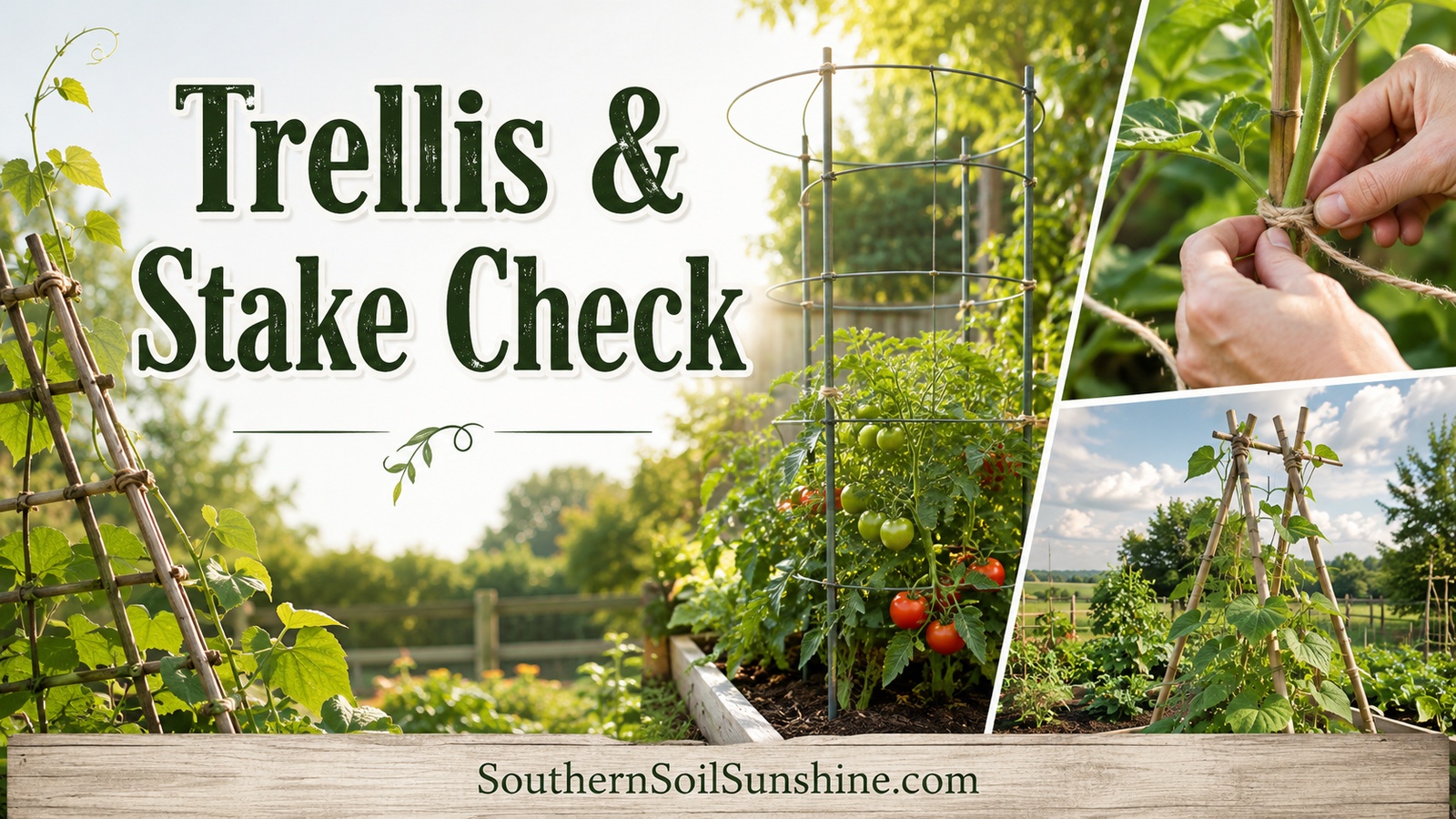
Give each stake a firm wiggle — if it moves in the soil, drive it deeper or replace it with something sturdier. Check that tomato cages are anchored so a heavy plant cannot tip them, adding a stake through the cage if needed. Make sure trellis posts are firmly set and panels securely fastened. And inspect your ties: as stems thicken, ties that were once loose can strangle the plant, so loosen or replace any that are biting in, using soft, wide materials like cloth strips or garden tape that will not cut.
Reinforce and Add Before You Need To
Beyond fixing weaknesses, late April is the time to add support the growing plants will soon need. Get stakes and trellises in place before plants require them, because it is far easier to guide a plant onto a support early than to wrestle a large, tangled one onto it later — and installing supports around an established plant risks damaging its roots. If your tomatoes will need taller cages, add the height now. If your pole beans or cucumbers are reaching for something to climb, make sure the trellis is ready and begin gently guiding them onto it. Getting ahead of the plants’ needs means they grow into strong support from the start, rather than flopping while they wait for you to catch up.
Make Sure Your Supports Can Hold the Season
This day’s question is one worth carrying far beyond the tomato patch: are your supports still strong enough to hold the season? In the garden it is literal — the stakes and trellises that will bear the weight of a summer’s growth. But the question echoes. Every season of real growth and fruitfulness, in a garden or a life, brings weight: the weight of increased responsibility, of abundance, of the very success we hoped for. And the supports that carry us through — our rhythms of rest, our relationships, our practices of prayer and renewal, the people and disciplines that hold us up — need to be checked and reinforced before the heavy season arrives, not after we are already sagging under a load they were never strong enough to bear.
How often we grow toward a fruitful season without ever checking whether our supports can hold it — and then find ourselves collapsing, flattened by the very abundance we longed for, because the structures meant to sustain us were loose, shallow, or built for a smaller load. The garden invites us to be wiser: to inspect our supports in the lighter season, while there is still time and ease to strengthen them, so that when the weight of growth arrives, we stand rather than break. So as you check your trellises and stakes today, let it ask you gently about your own supports. Are your rhythms of rest strong enough for the season coming? Your relationships? Your practices of renewal? Check them now, reinforce what is weak, and add what you will need — before the weight arrives. Supports checked early are supports that hold. Make sure yours can bear the season you are growing toward.
Share your trellises and support setups with us on Instagram @southernsoils — there is real wisdom in a garden built strong enough to hold its harvest.
Matching the Support to the Plant
Part of a good check-up is making sure each plant has the right kind of support for what it is about to become. A support that suits a pepper will never hold a full-grown indeterminate tomato. Here is a quick guide to what each of your heavy hitters needs.
| Plant | Best Support |
|---|---|
| Indeterminate tomatoes | Tall, sturdy cage or stake-and-tie; they get huge |
| Determinate tomatoes | Shorter cage; still needs anchoring |
| Pole beans | Tall trellis, teepee, or netting to climb |
| Cucumbers | A-frame or vertical trellis keeps fruit clean |
| Peppers | Light stake for heavy-fruited types |
If you discover a plant is under-supported for what it is becoming — an indeterminate tomato in a flimsy little cage, a pole bean with nothing tall to climb — now is the moment to upgrade, while the plant is still small enough to move onto a better support without damage. A few weeks from now, that same fix becomes a wrestling match with a heavy, tangled plant. Right-sizing the support now is one of the highest-value things you can do for your summer harvest.
A Few Minutes That Saves a Whole Plant
It is worth pausing to appreciate the return on this small task. A support check-up takes perhaps twenty minutes of walking, wiggling, and reinforcing. What it prevents is the loss of an entire fruit-laden plant — weeks of growth, a summer’s worth of tomatoes, gone in the moment a weak stake gives way in a storm. Few tasks in the whole garden offer such a lopsided trade: a handful of minutes now against the potential loss of your best plants later. This is preventive gardening at its finest, the quiet, unglamorous work that never gets photographed but quietly saves your season.
And like most preventive work, its value is invisible when done well. If you reinforce your supports today and a storm comes through in July, you will simply notice your plants still standing while others lie flattened — and you may never consciously connect it to the twenty minutes you spent in April. That is the nature of prevention: its reward is the disaster that never happens. Do the quiet work anyway. Your standing, fruit-heavy plants in the height of summer will be the proof, even if you have long forgotten the morning that made them possible.
Strong Supports, Standing Harvest
So take the walk today, wiggle every stake, test every trellis, loosen every tie that has grown tight, and reinforce or replace anything that would not survive a storm with a full crop hanging from it. Add the supports your growing plants will soon need, and guide the climbers gently onto them now. It is humble, preparatory work with no immediate payoff to admire — but it is exactly the kind of quiet foresight that carries a garden through its heaviest, most fruitful season intact. Make sure your supports can hold the weight of what you are growing. Do it now, in the lighter days, before the abundance arrives — and when the harvest comes in heavy and the summer storms roll through, your plants will still be standing, held up by the strength you built into them today.
Twenty minutes of checking and reinforcing today is one of the quiet, high-value gifts you can give your garden — and a fitting reminder to check the supports holding up your own life, too, while the season is still light enough to strengthen them.
Ready to Go Deeper in the Garden?
If this article resonated with you, you might be ready for something more than tips.
- Download the FREE Rooted in Grace eBook
- Join Rooted Reset
- Follow on Instagram – @southernsoils
“The garden is not just a place to grow plants – it is a place to grow yourself.”
Free eBook
Before you go — the book is yours
Rooted in Grace: A Christian Guide to Intuitive Gardening. No cost, no catch. Read it on any device, at whatever pace the season allows.