The Mid-May Garden Journal: Writing What You See and What You Sense
A Rest Day for Noticing ✍️
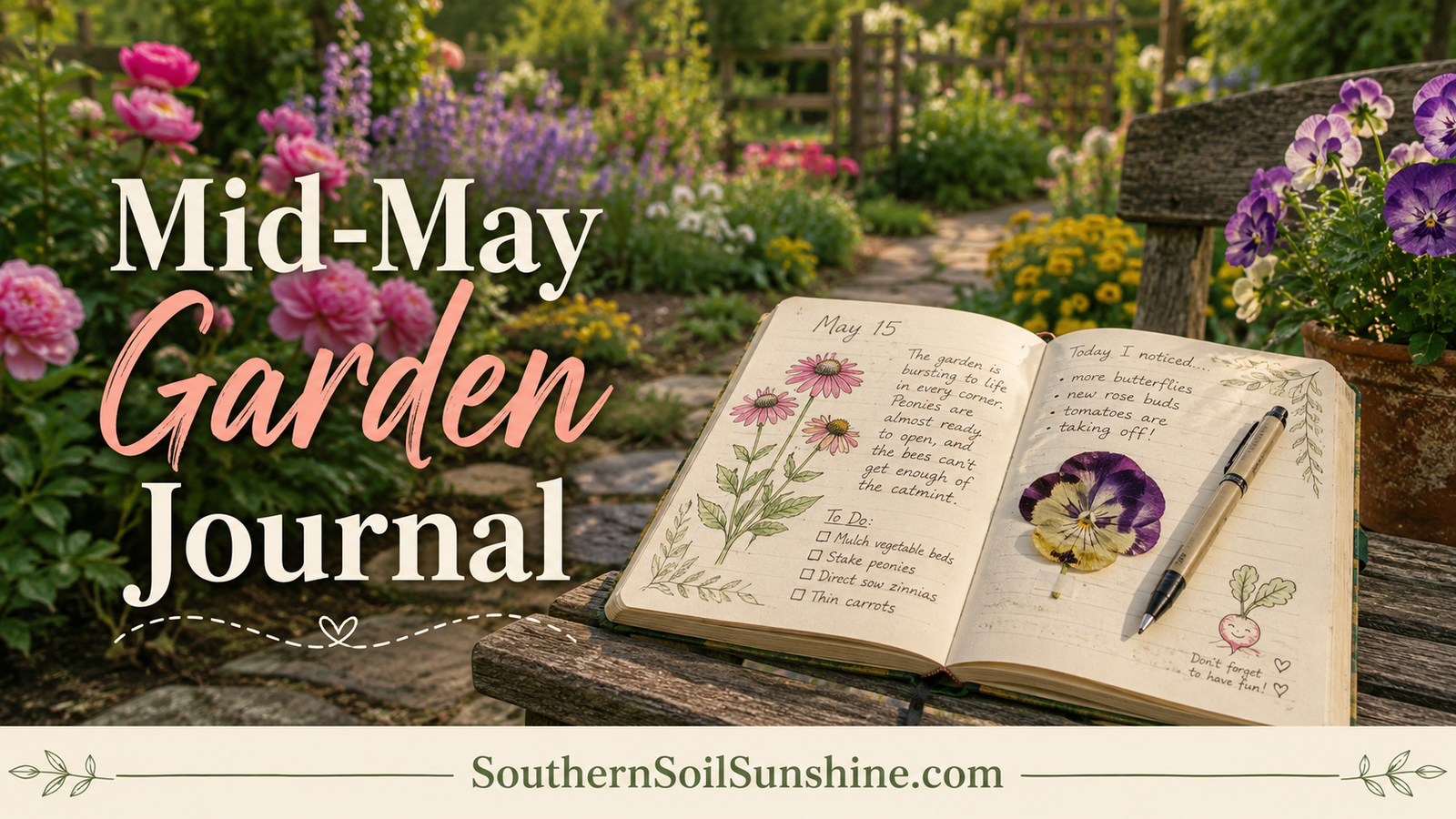
Mid-May is a rich moment in the Zone 9 garden. The spring crops are giving their last, the summer crops are coming on strong, and everything is in a state of lush, active transition. It is the perfect time for a gentle rest-day practice: to sit with your garden journal and simply record where things are — not with a busy list of tasks, but with the quieter, deeper attention of noticing. Today’s invitation is not to do in the garden but to see it, and to write down both what you see and what you sense. Garden journaling at its best is exactly this: a practice of paying loving attention and capturing it on the page.
This day’s phrase says it beautifully: write what you see and what you sense. Let me offer you a way to keep a mid-May garden journal that holds both the observed and the felt, and share why this practice of attentive noticing is one of the most quietly transformative things a gardener can do.
Free eBook
Rooted in Grace
A Christian guide to intuitive gardening — the whole book, free. Tell me where to send it and it’s yours in a minute.
Why a Garden Journal Matters
A garden journal is far more than a planting record, though it is that too. Over seasons, it becomes a living memory of your garden and your growth alongside it — a place that holds what you planted and when, what thrived and what failed, what surprised you, what you learned, and how you felt moving through the seasons. It makes you a better gardener, because reflection is how we learn; the gardener who records and reviews carries forward wisdom that the one who never writes simply forgets and must relearn. And it makes gardening richer, turning fleeting moments of beauty and discovery into a record you can return to.
But the deepest gift of a garden journal is what the act of keeping it does to you. To journal your garden well, you must slow down and truly look — and that attentive looking changes how you experience the whole garden. You begin to notice what you would have hurried past. You see the subtle changes, the small dramas, the quiet beauty. The journal is not just a record of attention; it is a practice that cultivates attention, and attention is the root of nearly everything good in gardening.
Writing What You See
Start with the observable — the concrete, factual layer of what is actually happening in your garden today. This is the practical record, and it is genuinely useful.
| Note What You See | For Example |
|---|---|
| What is growing & how | Tomatoes flowering; beans nearly done |
| What you harvested | Last of the lettuce; first cucumbers |
| Weather & conditions | Heat climbing; soil drying faster |
| Problems & pests | A few aphids; a squash struggling |
| What you did | Mulched, fed, sowed a second wave |
Walk your garden slowly and jot these observations — the date, what is thriving, what you picked, how the weather is turning, any troubles you spot. This factual layer is the backbone of a useful journal, the record you will return to next year to remember when the heat arrived, which varieties did well, when the cucumbers first came in. Keep it simple and specific.
Writing What You Sense
Then go deeper, to the layer most garden journals miss: what you sense. Beyond the facts, what do you feel and perceive as you move through your garden today? The particular quality of the light. The scent of the soil and the herbs. The satisfaction or the worry in your own heart. The sense of a season turning, of abundance coming or fading. The small joys, the quiet gratitude, the things the garden is stirring in you. This is the reflective, sensory, even spiritual layer, and it is what turns a planting log into a true journal — a record not just of your garden but of your life among it.
Keeping It Simple and Sustainable
The best journal is the one you actually keep, so do not let it become a burden. A plain notebook and a few honest lines beat an elaborate system abandoned after two weeks. You need not write every day — a regular rhythm, even just weekly, builds a rich record over time. Let some entries be all practical observation and others turn reflective; both are good. The point is not to produce a beautiful document but to build a faithful habit of noticing and recording, in whatever simple form you will sustain.
Write What You See and What You Sense
This day’s phrase is one I have come to love as a way of living, not just journaling: write what you see and what you sense. It names two kinds of attention we need — the outer and the inner, the observed and the felt — and it insists that both matter. So often we record only the facts, the measurable and the practical, while the deeper layer of what we sense goes unnoticed and unnamed. But it is in attending to both, the seen and the sensed, that we come to truly know a garden, a season, a life.
There is real formation in this practice. To regularly write what you see is to train yourself in honest observation — to look clearly at what is actually happening rather than what you assume or wish. And to write what you sense is to honor your inner life, to notice the movements of your own heart and spirit that we so easily rush past unexamined. Together, they cultivate a rare and valuable quality: the capacity to be truly present and attentive, awake to both the world outside and the life within. The garden journal is a small school for this. So take this rest day and keep it — walk your garden slowly, and write both what you see and what you sense. Record the tomatoes flowering and the light on the beans; record the gratitude, the worry, the turning of the season in your own heart. In writing both, you are not only keeping a garden journal. You are practicing a way of paying attention that will make you more present to your whole life — which is, in the end, one of the truest things the garden has to teach.
Share pages from your garden journals with us on Instagram @southernsoils — there is quiet beauty in a gardener who takes the time to truly notice.
Prompts for a Mid-May Entry
If a blank page feels daunting, let a few gentle prompts open the writing. Answer only the ones that call to you — some days you will linger over one, other days you will touch them all lightly.
| See | Sense |
|---|---|
| What is thriving right now? | What am I most grateful for today? |
| What did I harvest this week? | What is the garden stirring in me? |
| What is struggling or changing? | What worry can I lay down here? |
| How is the season turning? | Where have I noticed grace lately? |
Notice how the two columns work together — the outer observation on the left, the inner sensing on the right. You might answer a “see” prompt and let it lead naturally into a “sense” one: the beans are nearly finished (what I see), and I feel a small tenderness at the ending of the spring crops (what I sense). Let the observing open the door to the sensing. That movement, from the outer to the inner, is where a garden journal becomes something deeper than a record — a place where paying attention to the garden becomes paying attention to your own life.
A Record Worth Keeping
Years from now, these mid-May pages will be a quiet treasure. You will open them and be transported — to the particular light of this spring, the first cucumbers, the tomatoes just beginning, the state of your own heart in this season of your life. A garden journal is one of the few records that captures not just what we did but who we were and how we saw, season by season, as we grew alongside our plants. And it costs so little to keep: a notebook, a pen, a few honest minutes on a rest day. The gardeners who keep them rarely regret it; the ones who did not almost always wish they had. So begin, or begin again, today. Write this mid-May moment down — what you see and what you sense — and start building the kind of record that will feed you, in memory and in wisdom, for all the gardening years to come.
Rest, and Notice
One last gentle word: this is a rest day, so let the journaling be restful, not another task to accomplish. If the notebook starts to feel like pressure, set it down and simply be in your garden — the noticing can happen with no pen at all. Sometimes the truest entry is written later, after you have simply sat among your plants and let the season sink in. Rest first, notice freely, and write only as it comes. The point is not a full page but a present heart. Give yourself the gift of this slow, attentive day, and let both your garden and your own quiet noticing be enough.
Open the notebook today, or simply open your eyes and heart to the garden — and let this mid-May practice of writing what you see and what you sense become a habit that keeps you present to every season still to come.
Ready to Go Deeper in the Garden?
If this article resonated with you, you might be ready for something more than tips.
- Download the FREE Rooted in Grace eBook
- Join Rooted Reset
- Follow on Instagram – @southernsoils
“The garden is not just a place to grow plants – it is a place to grow yourself.”
Free eBook
Before you go — the book is yours
Rooted in Grace: A Christian Guide to Intuitive Gardening. No cost, no catch. Read it on any device, at whatever pace the season allows.