
Thinning Spinach and Lettuce: The Kind Cut That Makes What Stays Grow Stronger
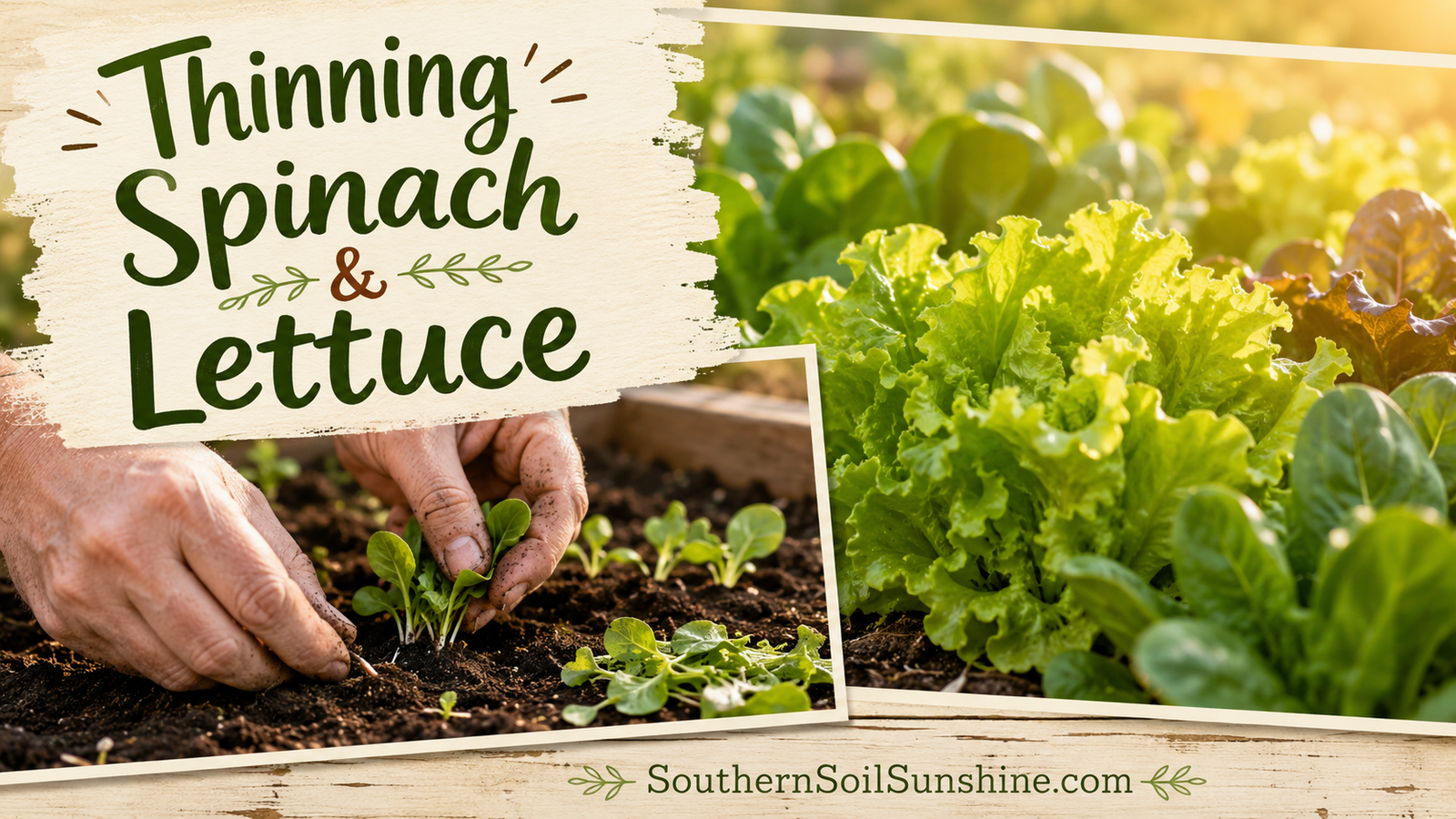
The Hardest Easy Task in the Cool-Season Bed 🌿
There is a moment in every cool-season bed that catches beginning gardeners off guard. You did everything right. You scattered your spinach and lettuce seed back in the mild days of winter, you kept the soil damp through those quiet weeks, and now you have a green haze of seedlings so thick and hopeful it feels like a small miracle. And then someone tells you the hardest thing a new gardener can hear: you have to pull most of them out.
I remember how much I resisted this the first year. It felt wasteful, even a little cruel, to reach into a crowd of healthy sprouts and remove the ones that had done nothing wrong except grow too close to their neighbors. But thinning is not punishment. Thinning is how you tell the plants that stay, you have room now — grow. Here in Zone 9, where late January is one of our best windows for tender greens, learning to thin well is the difference between a bed of pale, bolting, disappointing lettuce and a bed of full, sweet heads you will be proud to set on the table.
Free eBook
Rooted in Grace
A Christian guide to intuitive gardening — the whole book, free. Tell me where to send it and it’s yours in a minute.
Why Crowded Greens Never Reach Their Potential
Spinach and lettuce seed is small, and we almost always sow it more thickly than we need to. When those seedlings come up shoulder to shoulder, they begin to compete for the three things every leaf needs: light, water, and root space. Crowded greens stretch tall and thin reaching for sun, their stems weak and leggy. Their roots tangle and fight for the same pocket of moisture, so none of them drink deeply. And in our humid Houston air, a dense mat of leaves that never dries out becomes an open invitation for downy mildew and rot.
The plants are not failing. They are simply doing what living things do in a crowd — surviving, not thriving. Your job is to open the space so thriving becomes possible. It helps to remember that a thinned bed is not a smaller harvest. It is a larger one, because a dozen full heads of lettuce will always outweigh fifty stunted ones fighting over the same square foot of soil.
When to Thin, and How Much
The right time to thin greens is when the seedlings have their first one or two “true” leaves — the second set that looks like miniature versions of the adult plant, not the first rounded seed leaves. In our Zone 9 winter, that usually lands about two to three weeks after germination.
You will thin in two gentle passes rather than one drastic one. The first pass opens up breathing room; the second, a week or two later, sets your final spacing once you can see which seedlings are the strongest.
| Crop | First Thinning | Final Spacing | What to Do With Thinnings |
|---|---|---|---|
| Leaf lettuce | To 4 inches apart | 6–8 inches | Eat them — baby lettuce is a treat |
| Head lettuce | To 6 inches apart | 10–12 inches | Transplant the strongest, eat the rest |
| Spinach | To 2 inches apart | 4–6 inches | Toss tender thinnings into a salad |
The trick is to keep the sturdiest, most upright seedlings and remove the weak, the leggy, and the doubled-up. Snip at the soil line with small scissors rather than yanking, so you do not disturb the roots of the keeper right beside it. And do not grieve the thinnings — rinse them and put them straight into that night’s salad. Nothing is wasted in a well-tended garden.
The Quieter Work Happening Underground
Here is what makes thinning feel less like loss once you understand it: the plants you leave behind will double, triple, sometimes quadruple in size because of the space you gave them. The energy that would have gone into competition now goes into growth. Roots spread wide instead of down into a fight. Leaves unfurl fully because light reaches every one. In a few short weeks you will walk past this bed and forget it ever looked crowded — you will only see the abundance you made room for.
This is worth remembering on the days thinning feels ruthless. You are not subtracting from your garden. You are choosing where its energy will go. And choosing is always, in some quiet way, an act of faith — a belief that what remains is worth protecting.
A Simple Thinning Rhythm You Can Trust
If you are the kind of gardener who likes a clear plan, here it is. Walk your bed with scissors and a small bowl. Move slowly down each row. Where two seedlings crowd, keep the stronger and snip the weaker at soil level. Aim for your first-pass spacing, not your final spacing — you are opening room to breathe, not setting the whole bed today. Water gently when you finish. Then come back in a week or two, once the keepers have filled in, and do a lighter second pass to reach final spacing. That is the entire art of it. Steady, unhurried, kind.
A Blessing for What Stays, a Release for What Goes
I have come to love thinning day, though it took me years to get there. There is something honest about kneeling in the winter soil and deciding, gently, what gets room to grow. As you thin, you are practicing something the garden teaches over and over: that making space is an act of care, not cruelty. That you cannot pour your best into everything at once. That releasing the good is sometimes how you protect the best.
So bless what stays. Release what goes, without guilt, into that evening’s bowl. And trust that the room you are making — in this bed, and maybe in your own overcrowded season — is exactly what allows the real growing to begin.
If a slow, tending morning in the garden speaks to you, come find us on Instagram @southernsoils, where we share the small daily practices that keep a garden and a heart rooted.
How to Choose Which Seedlings Stay
When you first kneel down to a crowded row, every seedling looks about the same — small, green, hopeful. But spend a minute looking closely and differences appear, and those differences are exactly how you decide. Keep the seedlings with the thickest, sturdiest stems, the ones standing upright rather than leaning or stretching. Keep the ones with the broadest, most deeply colored leaves. Remove the pale, the spindly, the ones that germinated late and are half the size of their neighbors, and the doubles where two seeds came up in the same spot.
You are not looking for the biggest seedling in every case — you are looking for the strongest, the one with the best structure to carry a full head of lettuce or a mature spinach plant. A slightly smaller seedling with a thick stem will almost always outperform a taller, leggier one. Trust the sturdy over the showy. That is a good rule in the garden, and not a bad one out of it.
A Baby-Greens Harvest From Your Thinnings
Here is the part that turns thinning from a chore into a small joy: everything you remove is edible, tender, and honestly some of the sweetest eating of the whole season. Baby lettuce and spinach thinnings, snipped at the soil line and rinsed, go straight into a salad, onto a sandwich, or over a bowl of soup. Micro-spinach wilted into scrambled eggs is a quiet luxury. You paid for that seed and tended it for weeks — there is no reason to compost what you can eat.
I keep a small colander with me on thinning day and drop the keepers-that-had-to-go straight into it. By the time I finish a bed, I have that night’s greens picked. It reframes the whole task. You are not throwing plants away. You are taking an early, gentle harvest while making room for the main one.
Thinning Is a Practice, Not a One-Time Event
It helps to know that thinning is rarely finished in a single morning. You will do a first light pass to open breathing room, then come back a week or two later once you can see clearly which plants are thriving, and do a second pass to reach final spacing. Some gardeners even thin a third time as heads begin to touch, harvesting every-other-plant young and letting the rest size up fully. This is not fussiness; it is simply staying in relationship with the bed as it grows, adjusting as the plants reveal themselves.
The same is true of the crowded places in a life. We rarely get to make one clean decision and be done. We open a little room, we watch what grows, we make more room as things become clear. Faithful tending is a practice of returning, again and again, to the same patch of ground with the same gentle attention.
A Note on Timing in Our Zone 9 Winter
Because our warm spells can arrive early and fast, do not put thinning off. A bed left crowded through a sudden 80-degree stretch is far more likely to bolt, and once cool-season greens decide to flower, their leaves turn bitter and the season is effectively over. Thinning promptly — on time, before stress sets in — is one of the simplest ways to hold onto sweet, tender greens for as many weeks as our mild winter will give us. When you see those first true leaves, that is your invitation. Do not wait for a more convenient day.
Ready to Go Deeper in the Garden?
If this article resonated with you, you might be ready for something more than tips.
- Download the FREE Rooted in Grace eBook
- Join Rooted Reset
- Follow on Instagram – @southernsoils
“The garden is not just a place to grow plants – it is a place to grow yourself.”
Free eBook
Before you go — the book is yours
Rooted in Grace: A Christian Guide to Intuitive Gardening. No cost, no catch. Read it on any device, at whatever pace the season allows.