Best Crops to Start Indoors in Zone 9 in September

Best Crops to Start Indoors in Zone 9 in September 🍂
There’s a particular magic that happens in September here in the Houston suburbs. The calendar tells us fall is coming, but the thermometer stubbornly insists it’s still summer. Our heat-loving tomatoes are gasping, the zucchini has finally surrendered, and we’re all dreaming of crisp lettuce and warming soups. Yet here we are—still sweating through 90°F afternoons, wondering how in the world we’ll transition to a fall garden.
This is exactly where indoor seed starting becomes your greatest gardening ally. I’ve learned over years of tending this zone that September isn’t too late—it’s actually perfectly timed. By starting seeds indoors now, you’ll have sturdy transplants ready to go into the ground just as October’s cooler weather arrives. It’s one of my favorite seasons to garden, and it all begins with what you sow this month in quiet trays under grow lights.
Free eBook
Rooted in Grace
A Christian guide to intuitive gardening — the whole book, free. Tell me where to send it and it’s yours in a minute.
Why September Seed Starting Matters in Zone 9 🗓️
Let me be honest: direct sowing cool-weather crops into September’s heat is practically futile. Seeds need moisture and moderate temperatures to germinate—not the baked, parched soil we’re dealing with right now. When I tried direct sowing broccoli seedlings in early September years ago, the heat stress was so severe that I lost nearly the entire crop before it even sprouted.
Starting indoors solves this problem beautifully. You’re creating a protected nursery where seeds can germinate in ideal conditions—steady moisture, gentle light, and air circulation—away from the September sun’s intensity. This is what I call the “prep phase,” and it’s absolutely essential for success in Zone 9.
Here’s what indoor starting gives us:
Protection from scorching heat and drought stress — Your delicate seedlings develop in controlled conditions, not fighting the brutal afternoon sun.
Defense against pests and birds — September pests are relentless. By keeping seeds indoors, you avoid cutworms, flea beetles, and hungry birds targeting your young plants.
Perfect timing for transplants — Most indoor-started crops will be 4–6 weeks old and ready to harden off right when our first cool fronts arrive in late September and early October.
Extended harvest windows — By transplanting established seedlings rather than tiny seeds, you gain precious weeks of growing time before true cold arrives.
Sanda’s Tip: Mark your calendar for mid-September planting if you want transplants ready by mid-October. In our zone, we’re working backward from our first light freeze date—usually around mid-November—and counting 6–8 weeks. That math puts us at seed starting right now.
The Best Crops to Start Indoors Now 🧑🌾
🥦 Brassicas: The Stars of Fall
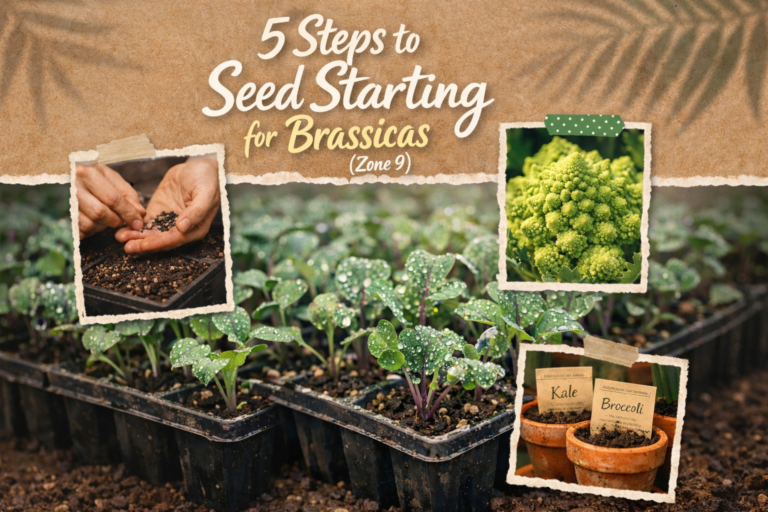
If there’s one crop that defines our Zone 9 fall garden, it’s brassicas. Broccoli, cauliflower, cabbage, and Brussels sprouts absolutely adore our October through February weather. But here’s the catch—they hate germinating in heat. These cool-loving crops need cooler conditions to even sprout reliably.
Start these indoors in September without hesitation:
Broccoli and cauliflower — These are my go-to transplants every fall. Both take 50–60 days from seed to a transplant-ready size, which means starting now gives you perfect timing. I prefer varieties like ‘Calabrese’ broccoli and ‘Snowball’ cauliflower for our region.
Cabbage (all types) — Green, red, and napa cabbage all thrive in our fall. Napa cabbage is particularly special because it grows so quickly once transplanted. Give it 4–5 weeks indoors and you’ll have sturdy starts.
Brussels sprouts — These take longer—up to 100 days—so starting now is essential. They’ll grow slowly through fall and produce heavily through winter.
Romanesco — This fractal beauty is technically a brassica, and it’s a showstopper in the fall garden. Give it the same care as cauliflower.
⚠️ Sanda’s Zone 9 Note: Do NOT place brassica seedlings on warm windowsills. If your kitchen gets afternoon sun and stays above 75°F, your seeds may bolt or refuse to germinate. Use a grow light in a cooler corner, or start them in a shaded room. I keep mine in my laundry room where it stays naturally cool.
When caring for brassica seedlings, use shallow trays with excellent drainage and air circulation. A small fan on low speed, running a few hours daily, prevents the fungal issues (damping off) that plague indoor seedlings. Water from below when possible, keeping soil moist but not waterlogged.
🌿 Leafy Greens: The Quick Wins
While some greens can be direct sown in late September and early October, starting them indoors gives you several advantages: protection from pests, a guaranteed supply of established plants, and the ability to transplant them with partial shade if the weather stays hot longer than expected.
Kale is almost foolproof. I’ve grown ‘Lacinato,’ ‘Curly Kale,’ and ‘Winterbor’ with equal success. They’re incredibly cold-hardy and productive.
Swiss chard bridges seasons beautifully—it grows through fall and will even tolerate light freezes. ‘Bright Lights’ is gorgeous, but any variety works.
Collards, mustard greens, and pak choi are all quick-growing, pest-resistant options that thrive in our fall weather. Pak choi is particularly wonderful for stir-fries and grows so quickly you’ll be harvesting in 6–8 weeks from transplanting.
Bottom-water your greens (from below rather than overhead) to prevent damping off, which loves the humid conditions of indoor seedling trays. If your seedlings get leggy or leaves outgrow their cells before transplant time, pot them up into 4-inch containers. They’ll appreciate the room and develop stronger root systems.
When transplanting greens into the garden, give them afternoon shade if daytime temps are still above 85°F. Once they’re established and the weather cools, they’ll tolerate full sun beautifully.
🧅 Bulbing Onions & Alliums: The Patient Growers
Onions are one of my favorite crops, but they require patience and planning. Most bulbing onions need 120–150 days to mature, which means we must start them incredibly early—actually, ideally in late August. But if you’re just now thinking about this, September starts will still give you good-sized transplants for the garden.
For Zone 9 Houston, short-day onion varieties are critical. We’re too far south for long-day types. Look for ‘Texas 1015 Y,’ ‘Candy,’ or ‘Vidalia.’ These varieties are bred for our latitude and will bulb properly in our climate.
Bunching onions (scallions) are much faster and more forgiving. Start these and you’ll have usable onions in 8–10 weeks.
Leeks are a longer-term investment—up to 100 days—but the reward is extraordinary. Our fall and winter weather is leek paradise.
Plant onion and leek seeds shallowly in wide, shallow containers (they like room to spread). Water gently but consistently. When seedlings are 3–4 inches tall, trim the tops back to encourage thicker growth rather than tall, spindly plants. Transplant when seedlings are pencil-thick.
Sanda’s Garden Wisdom: I trim my onion seedlings every week or two, cutting them back to 2–3 inches. This seems harsh, but it forces the plant to develop a stronger bulb base. Trust the process—by transplant time, you’ll have stocky, resilient starts.
🌼 Cool-Tolerant Herbs: The Flavor Layer
Many herbs genuinely thrive in our fall and early winter, and starting them indoors in September means they’ll be established and productive by the time we’re making soups and stews.
Parsley, dill, cilantro, and chervil are all cool-season herbs that love our October–February weather. I always start these indoors because direct sowing is slow and unreliable—these seeds prefer consistent moisture and gentle conditions.
Chives are nearly indestructible once established, but getting them started is easier indoors. You can even divide transplants to spread them across your garden.
Herb seeds are often tiny and slow to germinate. Sow them shallowly, keep soil consistently moist (not soggy), and be patient. Cilantro especially can take 2–3 weeks to germinate. When hardening off herb seedlings, do it gradually—they’re sensitive to sudden light changes. Move them to a sheltered, partly shaded spot for a few days before planting out.
Your Indoor Seed-Starting Setup 📦
Here’s the truth: you don’t need expensive equipment. I started my first seeds on a garage shelf with shop lights and have expanded only slightly from there. Here’s what actually matters:
| Essential Item | Why It Matters | Budget Option |
| Seed starting mix | Sterile, well-draining, disease-free | Buy in bulk or make your own with peat/coconut coir + perlite |
| Seed trays with drainage | Prevents waterlogging and damping off | Reuse yogurt containers, poke holes in bottom |
| Grow lights or sunny window | Seedlings need 12–16 hours of light daily | Shop lights with LED bulbs work fine (no expensive grow lights needed) |
| Spray bottle or watering can | Gentle watering prevents seedling damage | Any spray bottle; water when soil surface feels dry |
| Small fan | Air circulation prevents fungal disease | Clip fan on low, running 2–3 hours daily |
Optional but helpful: a heat mat for seeds that prefer warmth (though brassicas don’t), plant labels, and a simple garden journal to track what you planted and when. My journal is just a notebook where I write planting dates and variety names. It helps tremendously in planning for next year.
Common Mistakes (and How to Avoid Them) 🚫
Starting too late: If you’re reading this in late September, you’re cutting it close for brassicas. Aim to start seeds by mid-September for October transplanting. Leafy greens and herbs can still be started through late September.
Using warm locations: Your sunny kitchen windowsill feels like the obvious place, but it’s often too warm for germination. Cool rooms with grow lights work better. My seedlings live in the laundry room until they’re ready to face real weather, and I have never once regretted the extra trip down the hall.
Overwatering: This is the mistake I still catch myself making. Seed trays hold moisture far longer than garden soil does, and a tray that looks dry on top can be soaked an inch down. Lift the tray. If it still feels heavy, wait. Bottom-water only when the surface has gone pale and dry to the touch.
Skipping air movement: Damping off can take a whole tray overnight, and it almost always shows up where the air sits still. Two or three hours of a small fan a day is the cheapest insurance in seed starting.
Starting more than you can plant: I do this every single year. Forty broccoli seedlings and eighteen feet of bed. Count your square footage before you count your seeds — it is a kinder way to start.
Reading the Houston Heat: Timing Your Transitions 🌡️
One thing I’ve learned gardening here in the suburbs is that September feels deceptive. We’re technically in fall according to the calendar, but our soil stays warm—sometimes hovering around 80°F even as the month progresses. This warmth works against us when we’re trying to germinate cool-season seeds outdoors, but it’s actually perfect for indoor seed trays if we manage them carefully.
The secret is understanding that your indoor environment doesn’t have to match outdoor conditions. While your garden beds are still radiating summer heat, your seed trays can stay cool and moist indoors. I’ve found that keeping seedlings in the shadiest, coolest room of the house (mine is the laundry room with no southern exposure) makes an enormous difference in germination rates and seedling vigor. By late September, as our nighttime temperatures start dropping into the mid-70s, those indoor-started transplants will be exactly the right size to move outside just as the soil begins cooling.
This timing is particularly important because our Zone 9 fall actually spans nearly five months—from October through February—rather than the eight weeks many gardeners in cooler zones experience. That extended season is a gift, but it means we have to be strategic about when we start seeds so transplants mature during the optimal window rather than sitting stunted in the greenhouse or bolting prematurely in unexpected warm spells.
Hardening Off in Our Humid, Breezy Climate 💨
Moving seedlings from the gentle, controlled environment of indoors to the outdoor garden is always a transition, but in Houston’s suburban climate, it requires particular attention. Our humidity is intense—sometimes 80% or higher—which can lead to fungal issues on young plants if they’re suddenly exposed without acclimation. At the same time, our fall breezes can be surprisingly fierce and drying.
I approach hardening off gradually over seven to ten days. Week one, I move seedlings to a sheltered porch or carport where they get dappled light and filtered air. By week two, they can handle a few hours of morning sun and gentle breeze. The trick is watching the weather—if a cold front moves through during your hardening-off period, bring everything back inside for a day or two. There’s no penalty for moving slowly; rushing this step often kills more plants than any disease or pest.
One particular advantage of starting in September rather than trying to direct sow is that your transplants are already hardened by the time they go in the ground. They’ve developed thicker stems and stronger root systems indoors, so they recover more quickly from the transplant shock. This is especially valuable with brassicas, which can look wilted and sad for a day or two after moving—but if they’re well-established transplants rather than tiny seedlings, they bounce back beautifully.
The Soil You’re Starting Into: Preparing Your Garden Beds Now 🌱
While your seeds are germinating and seedlings are growing indoors, this is the perfect time to prepare your fall garden beds. September is when I work compost and aged manure into the beds where I’ll be transplanting in October. The soil has time to settle and integrate the amendments before the plants arrive.
Here in Houston, our summer heat often depletes soil life and compacts beds. I add at least two inches of compost to every bed, mixing it into the top six to eight inches. This both feeds the plants you’re about to transplant and rebuilds soil structure for better water retention—which matters because while our fall is cooler, it’s not necessarily wetter. A good compost foundation helps your transplants establish faster and handle any dry spells that slip in between rain systems.
I also use this prep time to think about spacing and succession planting. If I’m starting multiple trays of lettuce and greens, I know I won’t plant them all at once. Some go in early October for an October harvest, and I’ll direct sow or transplant more in late October and November for winter eating. Planning this now, while you have quiet time at your desk, beats scrambling in October when everything’s ready simultaneously. Make a simple sketch or spreadsheet—where will brassicas go, where will greens fill in, how much cilantro do you actually need this winter?—and you’ll plant with intention rather than panic.
Sanda’s Zone 9 Note: September’s prep work pays compound interest. The compost you turn in this month is feeding roots in November. The trays you fill this week become the greens on the table in December. Almost nothing you do in September looks like much on the day you do it — and almost all of it shows up later.
That is the part of gardening that took me the longest to trust. I want the work and the result in the same afternoon. The garden does not offer that, and neither, mostly, does God. He does the quiet work underground first, in the dark, where nobody is watching and nothing looks like progress yet. Then October comes and there is something to transplant.
So fill the trays. Set the light low. Water from below. You are not behind — you are early, which is a different thing entirely.
🛒 Shop This Post
Everything below is what actually sits on my seed-starting shelf in September — nothing fancy, nothing I do not reach for. Zone 9 seed starting is less about equipment than about keeping seedlings cool, keeping air moving, and keeping trays evenly moist.
- Organic Pro Seed Starting Mix, 16 qt Sterile and fast-draining, so damping off never gets a foothold.
- MIXC Seedling Trays with Humidity Domes Shallow cells with real drainage, and domes for the germination stage.
- Clip-On LED Grow Light, Full Spectrum Lets you keep trays in the coolest room instead of a hot windowsill.
- Small Clip-On Fan Two or three hours a day is the cheapest damping-off insurance there is.
- VIVOSUN Seedling Heat Mat For the herbs and onions that want warmth. Brassicas do not.
- KINGLAKE Plant Labels, 100 pc By week three every brassica seedling looks identical, and you will not remember.
- VIVOSUN 70 oz Pump Sprayer Gentle enough that it will not wash tiny seed out of the cell.
- Texas 1015Y SuperSweet Onion Seeds A short-day variety that actually bulbs at our latitude.
These are Amazon affiliate links. If you buy through them I earn a small commission at no extra cost to you, and I only link gear I actually use in my own Zone 9 garden.
Ready to Go Deeper in the Garden?
If this article resonated with you, you might be ready for something more than tips.
- Download the FREE Rooted in Grace eBook
- Get the Rooted in Grace Print Book on Amazon
- Join Rooted Reset
- Follow on Instagram – @southernsoils
- Save on Pinterest – @southernsoilsunshine
- Join on Facebook – Southern Soil Sunshine
“The garden is not just a place to grow plants – it is a place to grow yourself.”
Free eBook
Before you go — the book is yours
Rooted in Grace: A Christian Guide to Intuitive Gardening. No cost, no catch. Read it on any device, at whatever pace the season allows.