
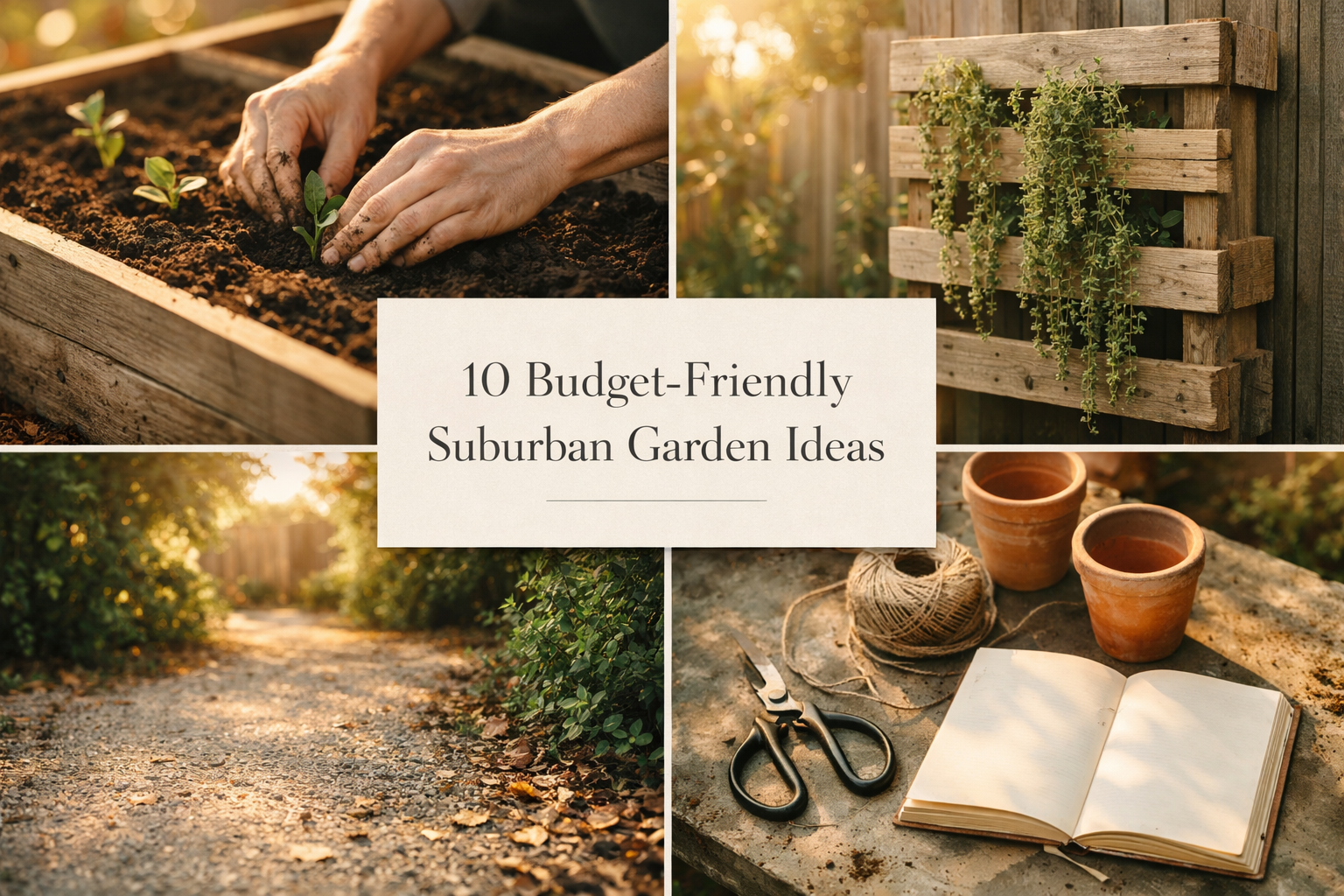
10 Budget-Friendly Suburban Garden Ideas That Feel Peaceful, not Overwhelming
Some of the links on this website are affiliate links, which means that if you make a purchase through these links, I may earn a small commission at no additional cost to you. As an Amazon Associate, I earn from qualifying purchases. I only recommend products I genuinely trust and believe will bring value to my readers. Also, some of the content was created with strategic use of AI tools. For more information, please visit the Privacy Policy page. Thank you for supporting my blog and helping me continue to provide valuable content. Gardening is more than growing food—it's where God grows us. If you're hungry for a faith that feels grounded again, I wrote a book for you. Download my free eBook: Rooted in Grace: A Christian Guide to Intuitive Gardening
There’s a quiet moment in the early morning when suburban neighborhoods are still.
The sprinklers have finished their hum. The birds are just beginning their soft hallelujahs. And if you step outside with your coffee, you might feel it — that gentle tug.
The garden doesn’t need to be bigger.
It doesn’t need to be Pinterest-perfect.
It doesn’t need to cost thousands.
It just needs your presence.
So today, I want to walk you through ten budget-friendly suburban garden ideas — not as hacks, but as gentle invitations. Ways to grow beauty, food, and peace without overspending or overdoing.
Because here’s the truth:
Small, faithful tending changes everything.
📌 Save This Guide for Later
Pin it now so you can come back anytime.
🌿 Why Budget Gardening Matters More Than You Think
If you’re gardening in a suburban backyard — HOA rules, limited square footage, real-life budget — you know the tension.
You want beauty.
You want abundance.
But you don’t want another expensive hobby draining your energy.
Budget gardening isn’t about being cheap.
It’s about stewarding wisely.
It’s about learning to notice what you already have — a theme I talk about often in my guide on how to build a small garden in Zone 9.
When we slow down and work with what’s here, instead of chasing what we think we need, something shifts.
The garden becomes less about performance.
And more about partnership.
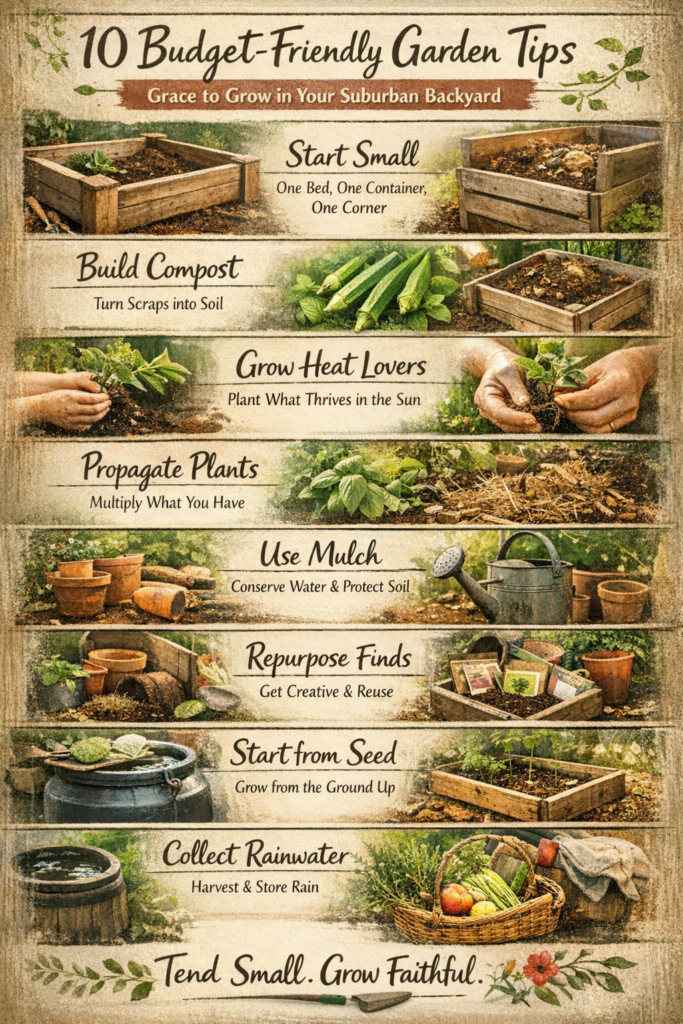
1️⃣ Start Small — One Bed, One Container, One Corner
The fastest way to overspend in a suburban garden isn’t the price of materials.
It’s overwhelm.
When we try to transform the entire backyard at once, we buy too much soil, too many plants, too many tools. And then the maintenance becomes exhausting.
In Zone 9, especially, our long growing season tricks us into thinking we have endless energy too.
We don’t.
Instead, choose:
• One 4×4 raised bed
• Or three large containers
• Or one sunny fence line
And commit to stewarding that space well.
Small spaces are not limitations.
They are clarity.
A contained space allows you to:
• Observe how the sun moves
• Notice where water pools
• Learn your soil texture
• Adjust without waste
If you need help designing wisely, I walk through this step-by-step in Zone 9 garden layout ideas for small spaces.
Intuitive gardening always begins with attention — not expansion.
2️⃣ Build Your Own Compost (Instead of Buying Soil Every Season)
Soil is the foundation of everything.
And in many suburban Zone 9 yards, native soil is either sandy and fast-draining or dense clay that cracks in summer heat.
Bagged soil is helpful — but expensive long-term.
Composting shifts your mindset from buying fertility to cultivating it.
Start simple:
• Vegetable scraps (no meat or dairy)
• Coffee grounds
• Dry leaves
• Grass clippings
• Shredded paper
Layer browns and greens. Turn occasionally. Let heat and time do their quiet work.
If you want a clear breakdown of how composting works in warm climates, this guide on The Complete Tropical Composting System walks you through it.
Compost teaches something powerful:
What looks like waste becomes nourishment.
Isn’t that how God works in us too?
3️⃣ Grow What Thrives in Heat (Not What Instagram Tells You To)
One of the most expensive gardening mistakes is fighting your climate.
In Zone 9 summers, temperatures regularly push above 95°F. Tender greens bolt. Tomatoes stall. Lettuce wilts by noon.
Instead of fighting summer, work with it.
Heat-loving crops include:
• Okra (thrives in 100° heat)
• Sweet potatoes
• Malabar spinach
• Cowpeas
• Zinnias
• Basil
Choosing the right plants reduces:
• Water waste
• Replacement purchases
• Fertilizer costs
• Frustration
If you’re unsure where to begin, here are my 10 easiest vegetables to grow in Zone 9.
The land is always communicating.
Intuitive gardening means listening.
4️⃣ Propagate from Cuttings
Budget gardening becomes sustainable when you shift from consumer to cultivator.
Many plants multiply freely if you let them:
• Basil roots easily in water
• Sweet potatoes create slips
• Mint spreads
• Rosemary can be propagated from cuttings
One healthy plant can become many.
Instead of buying six new herbs, start with one strong plant and learn to multiply it.
Propagation slows you down. It teaches patience. It requires observation.
And it builds confidence — because you’re participating in life, not just purchasing it.
5️⃣ Use Mulch Generously (It Saves Water and Money)
In hot suburban yards, bare soil bakes.
Water evaporates quickly. Roots overheat. Soil biology suffers.
Mulch changes the microclimate at soil level.
A 2–4 inch layer of:
• Shredded leaves
• Straw
• Pine bark
• Wood chips
Will:
• Reduce watering frequency
• Protect beneficial microbes
• Prevent erosion from heavy rains
• Suppress weeds
In the long run, mulch saves both money and labor.
If you’re unsure how thick to go or what type works best, this full guide to mulching in Zone 9 explains it clearly.
Mulch is gentle protection.
And sometimes protection is the most loving stewardship we can practice.
6️⃣ Repurpose What You Already Have
Before clicking “add to cart,” pause.
Look around your garage, patio, storage shelves.
You might already have:
• Buckets
• Cracked pots
• Old baskets
• Fence panels
• Wooden crates
With proper drainage holes, many items become usable containers.
Vertical gardening — especially in suburban lots — maximizes small spaces without expanding the footprint. I explain that more in how to create a vertical garden.
Creativity reduces cost.
But it also restores something inside us.
When we repurpose, we practice redemption.
7️⃣ Start Seeds Instead of Buying Starts
Buying transplants is convenient — but costly if repeated often.
Seeds cost far less per plant.
In Zone 9, we can start seeds:
• Late winter for spring crops
• Late summer for fall gardens
• Indoors during extreme heat
If you’re unsure how to begin, this guide on starting seeds in southern climates makes it simple and doable.
Seed starting also reconnects you with the full life cycle.
It reminds you that growth begins invisibly.
And invisibility is not weakness.
8️⃣ Harvest Water Wisely
Water bills climb quickly in summer.
Even one rain barrel, if allowed in your area, can supplement irrigation.
In heavy summer storms, gutters can collect significant runoff.
Beyond savings, water collection shifts your awareness.
You begin to notice:
• Storm patterns
• Roof flow
• Drainage direction
• Soil absorption
Water teaches attentiveness.
And attentiveness builds stewardship.
9️⃣ Plant Perennials for Long-Term Return
Annuals are beautiful — but they require replanting.
Perennials are long-term investments.
In warm climates, consider:
• Rosemary
• Oregano
• Thyme
• Sage
• Fig trees
• Blackberries
• Citrus
Plant once. Harvest for years.
Perennials reduce:
• Annual seed costs
• Labor
• Soil disturbance
They also embody covenant relationship — staying rooted instead of constantly starting over.
🔟 Follow a Simple Seasonal Rhythm
The most expensive mistake in suburban gardening isn’t plant choice.
It’s planting at the wrong time.
In Zone 9:
• Tomatoes go in early spring
• Greens go in fall
• Summer demands heat lovers
• Winter supports herbs and root crops
Without seasonal rhythm, crops fail and money is wasted.
I designed a realistic, step-by-step system here:
Grow Your Dream Garden in Just 15 Minutes a Day
Structure reduces stress.
Rhythm protects resources.
And rhythm, spiritually, builds peace.
🌞 Troubleshooting Budget Garden Struggles
Problem → Why It Happens → Gentle Fix
Overwatering → Trying to “save” plants → Let soil dry slightly; test before watering
Burned leaves → Afternoon heat → Add shade cloth or plant taller companions
Crowded beds → Over-planting → Thin ruthlessly; space brings airflow
Low harvest → Wrong season timing → Adjust planting window
Remember:
This isn’t failure.
It’s feedback.
🌸 Seasonal Notes for Zone 9 Gardeners
Spring
Start tomatoes and peppers early. Transplant before intense heat.
Summer
Focus on heat-loving crops. Mulch heavily. Water deeply, not daily.
Fall
Plant greens, carrots, broccoli September–November.
Winter
Herbs, radishes, carrots, leafy greens thrive beautifully.
Your rhythm may look different than northern gardeners — and that’s okay.
Let your zone guide you.
🤍 Faith Reflection: Stewardship Without Striving
“Let us not become weary in doing good, for at the proper time we will reap a harvest if we do not give up.” — Galatians 6:9
Budget gardening teaches endurance.
Not flashy abundance.
Not overnight transformation.
Just small, consistent faithfulness.
The garden reminds us:
We reap in season.
Not immediately.
And God is faithful in both.
📓 Journal Prompts
• Where am I trying to grow too much at once?
• What would “small and faithful” look like this season?
• What do I already have that I haven’t fully stewarded?
🌿 Related Garden Reading
• How to Build a Small Garden in Zone 9
• 10 Easiest Vegetables to Grow in Zone 9
• The Complete Tropical Composting System
• Grow Your Dream Garden in 15 Minutes a Day
🎙 Grow Deeper With Me
If this stirred something in you, the Rooted in Grace podcast on Apple and Spotify is waiting.
My book, Rooted in Grace, walks deeper into intuitive gardening as spiritual formation.
You can also find mentoring at southernsoilsunshine.com/coaching and community inside the Rooted Jesus Girls Facebook group.
You don’t have to grow alone.
🌼 Final Thoughts
A budget-friendly garden isn’t about spending less.
It’s about tending wisely.
It’s about noticing the sun-warmed soil.
Protecting tender shoots.
Trusting deep roots.
And remembering:
Small seeds change everything.
May your garden — and your heart — find rest in the slow places.