How to Evaluate Your Garden at the End of the Season (And Actually Learn Something)

How to Evaluate Your Garden at the End of the Season (And Actually Learn Something) 🌱
There’s a particular kind of quiet that settles over a Houston garden in late April and early May. The tomatoes are beginning to hit their stride, the herbs are lush and generous, and somewhere underneath all of that green abundance, you can already feel the season starting to shift. This is the moment — before the relentless summer heat consumes everything and before you dive headfirst into the next phase — to pause and actually look at what your garden has been trying to tell you.
I learned this the hard way after moving four times in three years. I used to skip the review entirely. I’d pull the spent plants, toss in some fresh mulch and soil amendments, and start planning next year’s garden with the same enthusiasm and the same blind spots. Every season, I’d repeat a version of the same mistakes, because I was measuring outcomes instead of noticing patterns. The squash bugs came back. The tomatoes in the same corner struggled again. The herbs I planted too far from the kitchen went neglected again. It wasn’t until I slowed down and actually *looked* — really looked — that things began to shift.
Intuitive gardening begins with attention, not action. Before you plant another seed or order another packet, spend time with what just happened. Your garden is a faithful teacher, but only if you’re willing to be a patient student. This is the spiritual heart of stewardship — recognizing that we learn most deeply when we’re willing to be humble about what we don’t yet understand.
Free eBook
Rooted in Grace
A Christian guide to intuitive gardening — the whole book, free. Tell me where to send it and it’s yours in a minute.
The Difference Between Outcomes and Patterns 📊
Most gardeners evaluate by tallying wins and losses: what produced abundantly, what failed, what got eaten by pests. That’s useful information, truly. But it’s surface-level, like reading the headline without the story. Patterns are deeper. They’re the quiet teachers that show up year after year if we’re paying attention.
A pattern is when you notice that every year, your east-facing bed underperforms not because of what you planted, but because of how the afternoon shade falls across it by mid-June. A pattern is realizing that the years you felt most connected to your garden were the years you watered slowly by hand in the early morning rather than setting a timer and walking away. A pattern is understanding that your neighbor’s tomatoes thrive in morning sun while yours need afternoon shade because your lot sits on a south-facing slope that bakes in summer heat.
Sanda’s Garden Wisdom: This season, as you walk your garden with fresh eyes, resist the urge to immediately problem-solve. Just notice. Bring a journal if that’s your way, or simply move slowly and let what you see settle before you draw conclusions. What you’re doing is practicing what I call attentive stewardship — the first principle of intuitive gardening. You cannot tend what you haven’t truly seen.
The Practice of Observant Reflection
Set aside an afternoon when you’re not rushed. Walk your garden slowly — I mean really slowly. Not the quick morning check-in where you deadhead a few things and hurry inside. Give yourself permission to spend 30 minutes to an hour just moving through your beds, noticing. What areas naturally draw you? Where do you feel resistance? Which plants surprised you? Notice the microclimates too. Where does morning dew linger longest? Where does the soil dry out first after rain? These observations are gold for intuitive gardening because they’re telling you something true about your specific place.
Start With the Soil, Not the Plants 🌍
Before you evaluate what grew, evaluate what’s beneath it. In Zone 9 and the Houston area especially, our soil tells a complicated story. The heavy clay holds moisture long after it’s welcome, turning into something resembling a clay pot by August. The alkaline pH can lock up nutrients that are technically present but unavailable to hungry plants. The compaction from Houston’s development means we’re often working against what nature handed us.
If your plants showed yellowing leaves mid-season, stunted growth, or blossom drop that didn’t improve with watering, the soil deserves a closer look before you blame the plants. The plants are often just messengers; the soil is where the real story lives.
What to Actually Do With Your Soil
Do a simple soil test — the kind you can get at most Houston-area garden centers or through Texas A&M’s Extension Service (they’re wonderful and thorough). Pay attention to pH, nitrogen, phosphorus, and potassium levels. But also do this simple thing that your senses can teach you: pick up a handful of soil from your best-producing bed and a handful from your worst-producing bed and compare them side by side. Look at the color. Feel the texture between your fingers. Smell both of them.
Healthy garden soil has a faint earthy sweetness to it — that smell is the microorganisms that are actually doing the work. Depleted soil often feels gritty or dusty, compacted or hollow. It smells flat, like nothing. Your hands know things your eyes might miss, and your nose knows even more.
Sanda’s Zone 9 Note: In Houston’s humid subtropical climate, drainage matters as much as nutrients do — sometimes more. If you noticed your beds staying waterlogged for days after rain, especially during our intense spring downpours, you’re dealing with a drainage issue that will repeat itself next year. Clay doesn’t just hold moisture; it holds it stubbornly. This is worth planning around now, before next season.
The Houston Clay Reality Check
Let’s talk about what’s really happening in our Zone 9 gardens. Many of us are working with clay soil that ranges from heavy to absolutely unforgiving. This isn’t a flaw in your gardening — it’s the reality of where we live. The question is: are you working with it or against it?
If your soil dried out and cracked within two days of watering, you likely need more organic matter — and I mean significant amounts. We’re talking 2-3 inches of compost or aged pine bark tilled into beds, not a light dusting. If it stayed soggy, you need drainage amendments: perlite, coarse sand, or a complete bed redesign using raised beds or bermed soil.
This evaluation moment is where you decide: are you going to keep fighting your soil, or are you going to work with what you have? Neither answer is wrong, but the clarity matters.
What Produced, and Why (The Honest Accounting) 🍅
Now comes the part where we notice outcomes without judgment. Make a simple list of what actually thrived in your garden. I’m talking about plants where you felt that quiet satisfaction — where they grew steadily, produced generously, and didn’t require constant nursing.
For each successful plant or bed, ask yourself: What made this work? Was it location? Soil preparation? The fact that you walked past it daily and noticed problems early? Did you have help — whether from a neighbor’s advice, a book you read, or simply luck? Were there specific actions you took — consistent watering, regular feeding, careful pruning — that seemed to matter?
Now do the same for what struggled. Not to beat yourself up, but to notice patterns. Did it fail because of your actions or because of conditions beyond your control? Did you neglect it, or did it simply dislike the location? Was it a variety choice that didn’t suit your Zone 9 heat, or a care issue?
| What Grew Well | Location & Conditions | What I Did Consistently | Zone 9 Factor |
| Cherry tomatoes | South-facing, afternoon shade cloth April-May | Hand-watered early morning, mulched heavily | Shade critical after mid-April heat arrives |
| Basil | Container near kitchen door, morning sun | Harvested regularly, pinched back before flowering | Thrived in heat once established; pinching extends season |
| Zucchini (early planting) | Raised bed, rich soil, consistent moisture | Fertilized every 2 weeks once flowering began | Early varieties done by early May; replant late July for fall crop |
The Pest and Disease Replay 🐛
Did you have squash bugs this year? Powdery mildew on your zucchini? Tomato hornworms? Spider mites on the herbs? Write it down. And more importantly, write down when it started and what weather conditions were happening.
In Houston, we’re not dealing with random pest invasions. They follow patterns related to our specific humidity, heat, and seasonal rhythms. Knowing that you typically see spider mites when we hit sustained temperatures above 85°F with low humidity is different from being blindsided by them. It means you can plan ahead — maybe choosing spider-mite-resistant varieties, or being extra vigilant with water misting during that predictable window.
Powdery mildew loves our spring season: warm days, cool nights, and humidity. Squash bugs need dry soil to lay eggs successfully. Knowing your garden’s pest patterns is like knowing your own body — it lets you respond preventatively rather than reactively.
The Intuitive Reflection: What Does Your Garden Want to Tell You? 💭
This is the heart of intuitive gardening. Before you make any changes, sit with what you’ve observed. Some questions worth journaling about or simply sitting with:
Where did I feel most at peace in my garden this season? Where did I feel most frustrated? Were there plants I genuinely enjoyed tending, or did I resent every trip out to water them? Did my garden feel like an expression of myself, or like a list of obligations?
Sometimes the most important pattern isn’t about what grew. It’s about what made you feel alive. A garden that produces abundantly but requires 10 hours of maintenance per week when you have five to give isn’t a successful garden for you — it’s a source of guilt. Conversely, a garden that seems small but brings you genuine daily joy is thriving in the truest sense.
Sanda’s Tip: Create a simple “Garden Reflection Journal” — even if it’s just a single page. Write down three things that brought you joy, three things that frustrated you, and three questions you have about next season. Come back to it in six months. You’ll be amazed at what you learn about yourself and your garden.
From Reflection to Intentional Planning 🎯
Only after you’ve genuinely observed and reflected should you start making plans. The temptation is to immediately fix everything — to order new varieties, rebuild beds, start fresh. But that’s how we repeat old patterns. Real change comes from understanding what happened and choosing differently based on actual knowledge rather than hope.
Based on what you’ve observed, decide: What will you keep doing exactly as you did it? What will you try differently? What will you let go of entirely
Reading the Seasons: Houston’s Unique Timeline
One pattern that emerges quickly for Zone 9 gardeners is recognizing that our “end of season” doesn’t match the gardening calendar you read about in national magazines. While gardeners in cooler zones are wrapping up in October, we’re often just getting started with fall crops. Late April and early May isn’t truly an ending for us — it’s a transition point, a hinge moment where spring productivity gives way to summer dormancy, and the whole rhythm of what we grow needs to shift.
This matters for your evaluation because it changes what questions you ask. Instead of “what failed this season,” you might ask “what thrived in spring that I can replant in late July for a fall harvest?” Your basil that bolted in the heat by June might actually be telling you something useful: it’s a spring and fall herb for us, not a summer one. Your zucchini that stopped producing by May isn’t a failure — it’s following its natural pattern in our climate. Understanding this difference means you’re no longer fighting the zone; you’re dancing with it.
The Watering Audit: Where Water Goes and Why It Matters
As you walk your garden during this reflection period, pay close attention to how water actually moves through your beds. This is less about how often you water and more about where water goes when it arrives. In Houston clay, water either runs off the surface entirely or pools and stays for days. Both extremes tell you something about soil structure and slope that you need to know before summer arrives.
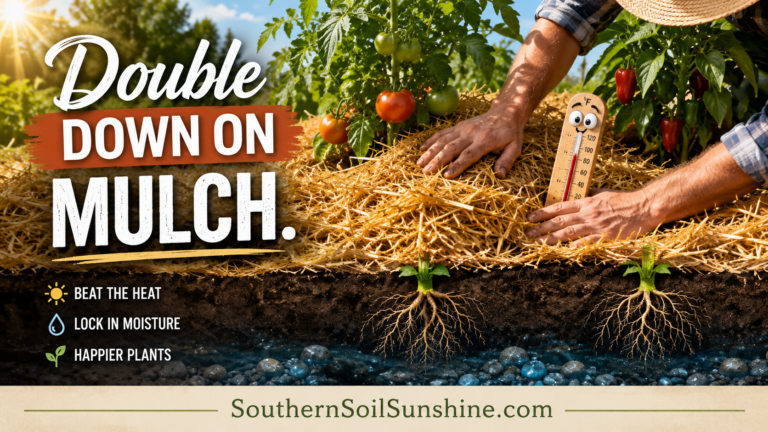
Notice which beds dry out fastest after rain and which stay boggy. Notice whether water pools near plant stems (a sign of compaction around the base) or distributes evenly. Notice if mulch is actually doing its job of slowing evaporation or if it’s crusted over and shedding water. These observations matter because they’ll determine whether you can sustain your garden through Houston’s brutal July and August without spending hours hand-watering. A garden that requires constant intervention isn’t sustainable — it’s a drain. But a garden where water moves intelligently through amended soil? That’s a garden that can thrive even when life gets busy.
Variety Selection: What Actually Likes It Here
This reflection is also the moment to honestly evaluate whether you’re growing varieties suited to what Zone 9 Houston actually offers. We can grow almost anything in spring because our winters are mild. But summer is our real filter. A tomato variety that produces beautifully in June might be completely done by mid-July when temperatures consistently hit 95°F. A lettuce that thrives in March becomes bitter and bolts by May. This isn’t a reflection on your skills — it’s simply the reality of where we garden.
As you note what succeeded, also note the specific variety names when you remember them. “I grew cherry tomatoes” is useful, but “I grew Sungold cherry tomatoes and they kept producing into early May with afternoon shade cloth” is gold. That specificity builds your personal database of what works in your microclimate. Over time, this becomes more valuable than any general gardening advice because it’s YOUR information, tested in YOUR soil, under YOUR sun exposure. When you evaluate, you’re not just assessing this season — you’re building the knowledge base that will make you a genuinely skilled gardener in your own place.
There’s something deeply formative about this kind of patient attention to place. We live in a culture that loves quick fixes and dramatic transformations, but a garden teaches us something different: that real growth happens through seasons of observation, small adjustments, and humble willingness to learn what our specific ground is trying
Ready to Go Deeper in the Garden?
If this article resonated with you, you might be ready for something more than tips.
- Download the FREE Rooted in Grace eBook
- Get the Rooted in Grace Print Book on Amazon
- Join Rooted Reset
- Follow on Instagram – @southernsoils
- Save on Pinterest – @southernsoilsunshine
- Join on Facebook – Southern Soil Sunshine
“The garden is not just a place to grow plants – it is a place to grow yourself.”
Free eBook
Before you go — the book is yours
Rooted in Grace: A Christian Guide to Intuitive Gardening. No cost, no catch. Read it on any device, at whatever pace the season allows.