
The Listening Walk: A Quiet October Practice for Your Fall Garden
A Different Kind of Garden Task 🍂
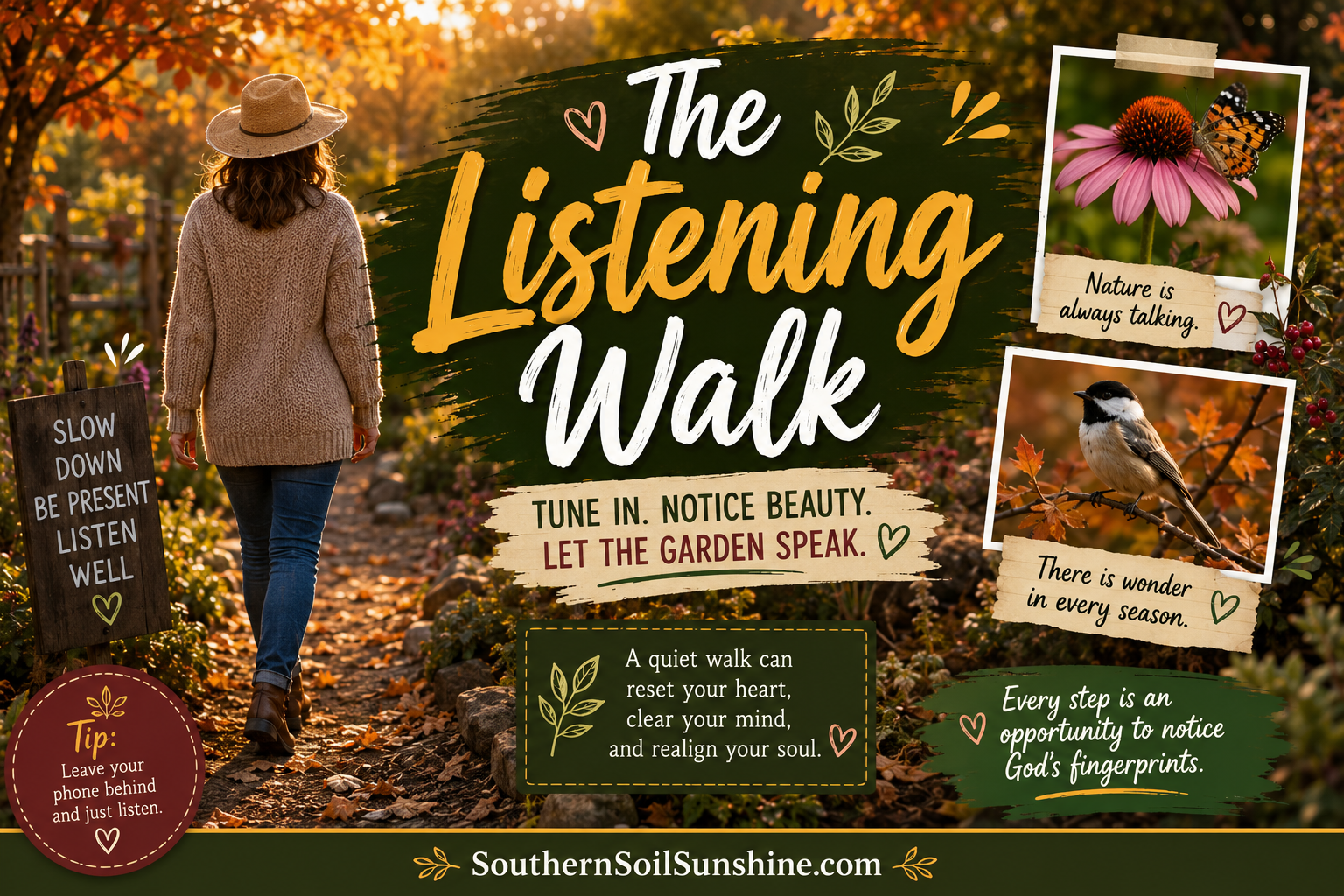
By late October in Zone 9, the garden has softened. The brutal heat has finally broken, the fall crops are growing in the gentler light, and there is a stillness to the garden that summer never allowed. This is the perfect season for a different kind of garden practice — not a task of doing, but a practice of noticing. A listening walk is exactly what it sounds like: a slow, quiet, unhurried walk through your garden with no goal but to pay attention. No harvesting, no weeding, no fixing — just walking, looking, and listening to what the garden has to show you. It is one of the most valuable and most overlooked practices a gardener can keep, and October’s gentle beauty is the ideal invitation to begin.
This day’s task is to take a slow listening walk through your garden, and it carries a still phrase: be present before you produce. Let me describe how to take a good listening walk, and reflect on why being present before you produce is such restorative wisdom.
Free eBook
Rooted in Grace
A Christian guide to intuitive gardening — the whole book, free. Tell me where to send it and it’s yours in a minute.
What a Listening Walk Is (and Isn’t)
A listening walk is a deliberate practice of presence, and its power comes precisely from its restraint.
| A Listening Walk Is | A Listening Walk Is Not |
|---|---|
| Slow and unhurried | A quick task-focused check |
| Noticing without fixing | Weeding, harvesting, working |
| Using all your senses | Only looking for problems |
| Receptive & quiet | Planning & producing |
The essential discipline of a listening walk is to resist doing. The moment you start pulling a weed or picking a tomato, you have shifted from presence to production, and the deeper noticing stops. So on a listening walk you keep your hands still and your senses open: you look closely at colors and growth and light; you listen to the birds, the insects, the wind; you smell the soil and the herbs; you touch leaves and feel the air. You move slowly, pausing often. You are not scanning for tasks or problems — you are simply being present to the garden as it is, receiving what it shows you rather than imposing your agenda on it. It is a small act of humility and rest, and it changes your whole relationship with the garden.
What You’ll Notice When You Slow Down
The surprising reward of a listening walk is how much you see that you always miss when working. Moving through the garden at the pace of presence rather than productivity, you begin to notice the things that speed hides: the particular quality of the autumn light, the bee working a late bloom, the way a plant has quietly changed, the first fall seedling emerging, a color or texture you had never really seen. You notice how the garden feels, its mood in this season. And often, paradoxically, you notice the genuinely important things — a subtle sign of a plant’s health, a shift worth responding to later — precisely because you were not rushing past them in task mode. Presence sees what productivity cannot. The gardener who only ever works the garden knows it far less well than the one who also, sometimes, simply walks it and listens.
Making It a Practice
A single listening walk is refreshing, but the real gift comes from making it a rhythm. Try to take one regularly through the gentle fall season — once a week, or whenever you feel yourself relating to the garden only as a to-do list. Over time, this practice deepens your knowledge of your garden immeasurably, because you come to know it not just as a set of tasks but as a living place you are genuinely present to. It also does something for the gardener: it restores the wonder and rest that first drew many of us to gardening, which the endless work can slowly bury. And you may find, as many do, that the listening walk becomes a kind of prayer — a quiet, receptive time among growing things that settles the soul as much as it informs the gardener. Keep it as a practice, and it will feed both your garden and you.
Be Present Before You Produce
This day’s phrase gently reorders everything: be present before you produce. So much of our life in the garden — and everywhere else — is spent producing: doing, fixing, achieving, working through the endless list. And that work is good and necessary. But the listening walk insists on a deeper truth: that presence must come before, and beneath, production — that we are meant first to be with the things we tend, to notice and receive them as they are, before we set about doing to them. A gardener who only ever produces, never present, loses touch with the very life they are tending. Presence is not a waste of time subtracted from the real work; it is the ground the real work should grow from.
And how deeply our lives need this reordering. We are so thoroughly trained to define ourselves by producing — by output, achievement, the visible fruit of our doing — that we scarcely know how to simply be present anymore: present to the people we love, to the moment we are in, to God, to our own lives as they actually are. We rush through everything in task mode, fixing and achieving, and in the rushing we miss almost everything that matters. The listening walk is a small, gentle rebellion against this — a deliberate practice of being present before, and beneath, all our producing. It teaches us that we are human beings, not human doings; that the world, and the people in it, and the God who made them, are to be received and attended to, not merely worked upon. So take your slow, quiet walk through the October garden today, hands still and senses open, doing nothing but being present. And let it teach your whole life the same holy reordering: be present before you produce. The being is not a break from the real thing — it is the root of it.
Share what you noticed on your listening walk with us on Instagram @southernsoils — there is real restoration in being present before you produce.
A Simple Way to Begin
If a listening walk feels awkward at first — and it may, for hands and minds trained only to work — a little gentle structure helps you settle into it.
| Sense | What to Notice |
|---|---|
| Sight | Colors, light, new growth, small changes |
| Sound | Birds, insects, wind, rustling leaves |
| Smell | Soil, herbs, the scent of fall air |
| Touch | Leaf textures, cool air, warm sun |
Begin by simply standing still at the garden’s edge for a moment and taking a slow breath before you step in. Then move through it one sense at a time: first just looking, taking in the colors and the autumn light; then closing your eyes for a moment to listen to the birds and insects and wind; then noticing what you smell; then touching a few leaves and feeling the air on your skin. Moving deliberately through the senses this way gives your restless mind something gentle to do and keeps you from sliding back into task mode. After a few walks, the structure falls away and presence comes more naturally — you simply walk, and notice, and receive. Like any practice of stillness, it grows easier and richer with repetition. The awkwardness of the first few walks is only the unlearning of a lifetime of hurry, and it passes.
The Gift You Carry Back Inside
Perhaps the truest measure of a listening walk is not what you notice in the garden but what you carry back inside with you. A gardener who steps out harried and task-driven and takes even ten unhurried minutes to be genuinely present among growing things tends to come back in settled, quieted, restored — carrying some of the garden’s stillness into the rest of the day. This is the deep gift of the practice: it does not just teach you your garden, it re-teaches you how to be present, a capacity our hurried lives steadily erode. And that recovered presence follows you — into your work, your home, your relationships, your prayers — long after the walk has ended.
So take your listening walk this week, in the gentle beauty of the October garden. Keep your hands still and your senses open, resist the pull to fix and produce, and simply be present to the living place you tend. Let it refresh your knowledge of your garden and, more, let it refresh your very capacity for presence. And carry its lesson into all of life: that beneath and before all our necessary producing, we are meant first to be present — to our gardens, our people, our God, and our own lives. Be present before you produce. Begin in the garden this October, and let the stillness spread from there into everything.
Bringing a Child or Friend Along
A listening walk is a quiet, solitary practice at heart, but it can also be a gift to share — especially with a child. Children are natural listeners in a garden; they notice the beetle on the leaf, the color of a late bloom, the sound of a bird, all the small wonders that adults in task mode walk right past. Invite a little one to walk slowly with you and simply name what they notice, and you may find they teach you more about presence than any practice could. The same is true of walking with a friend in companionable near-silence, each of you noticing aloud only now and then. Shared this way, the listening walk becomes not only a practice of presence to the garden but a practice of presence to one another — unhurried, attentive, together. In a world that rushes everyone past everything, a slow walk among growing things, given to a child or a friend, is a quiet and lasting gift. Be present before you produce — and now and then, invite someone you love to be present with you.
Ready to Go Deeper in the Garden?
If this article resonated with you, you might be ready for something more than tips.
- Download the FREE Rooted in Grace eBook
- Join Rooted Reset
- Follow on Instagram – @southernsoils
“The garden is not just a place to grow plants – it is a place to grow yourself.”
Free eBook
Before you go — the book is yours
Rooted in Grace: A Christian Guide to Intuitive Gardening. No cost, no catch. Read it on any device, at whatever pace the season allows.