Succession Sowing Lettuce and Spinach: Small, Steady Plantings for a Longer Harvest
The Secret to Greens That Never Run Out 🥬
Here is a small shift in how you plant that changes everything about your salad bowl: instead of sowing all your lettuce and spinach at once, sow a little every couple of weeks. It sounds almost too simple to matter, but this practice — called succession sowing — is the difference between one big flush of greens that all comes ready at once (and then bolts and is gone) and a steady, rolling harvest that keeps your kitchen supplied for weeks and weeks. In late March, with our Zone 9 spring warming quickly and the clock ticking toward the heat that will eventually end our greens, small and steady is exactly the right way to plant.
This day’s task is to direct-sow a fresh, small planting of lettuce and spinach, and it carries a beautiful phrase: keep planting small starts of grace. Let me show you how succession sowing works, why it is perfect for our climate right now, and why those small, steady plantings are such a fitting picture of a faithful life.
Free eBook
Rooted in Grace
A Christian guide to intuitive gardening — the whole book, free. Tell me where to send it and it’s yours in a minute.
What Succession Sowing Actually Means
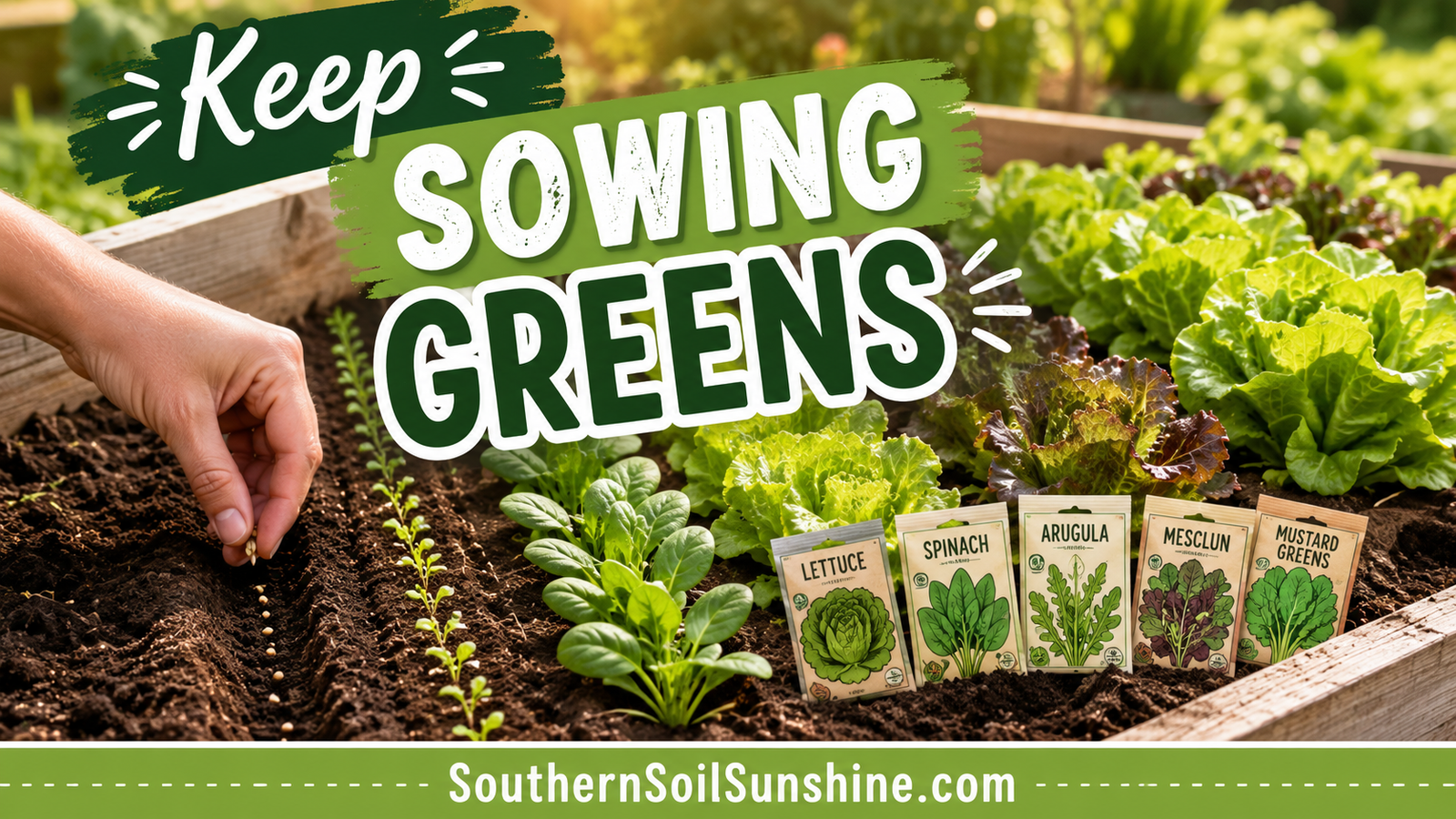
Succession sowing simply means planting small amounts of a crop at regular intervals rather than all at once. Instead of sowing a whole packet of lettuce on a single day, you sow a short row today, another short row in two weeks, another two weeks after that. Each planting matures a little after the one before it, so instead of thirty heads of lettuce all ready in the same week — far more than you can eat before they bolt — you get a steady handful ready to harvest at any given time, week after week.
For fast, cut-and-come-again greens like leaf lettuce and spinach, this is transformative. These crops do not hold well in the garden once mature, especially as our weather warms; they quickly turn bitter and bolt to seed. A single big planting means a brief glut followed by nothing. Small, staggered plantings mean a long, continuous harvest — the same amount of seed and effort, spread out into a supply that actually matches how you eat.
A Simple Succession Schedule
You do not need anything complicated — just a rhythm and a little space held in reserve.
| Crop | Sow Every | Zone 9 Note |
|---|---|---|
| Leaf lettuce | 2 weeks | Shift to heat-tolerant types as spring warms |
| Spinach | 2 weeks | Sow while cool; it bolts fast in heat |
| Arugula & Asian greens | 1–2 weeks | Fast; great for gaps |
Sow a short row or a small block today, water it in, and mark your calendar to do it again in two weeks. Keep a little open ground in reserve for each new sowing, or simply replant into space that opens up as you harvest earlier plantings. In our climate, favor heat-tolerant lettuce varieties as spring advances — they will carry you further into the warming weeks before bolting ends the season. Spinach is the first to give up as it heats, so get your spinach successions in while the weather is still cool.
Keeping the Harvest Rolling
The real magic of succession sowing shows up in how you harvest. With leaf lettuce and spinach, pick the outer leaves and let the center keep growing, and each plant gives you multiple harvests before it is spent. Combine that cut-and-come-again picking with your staggered plantings, and you create overlapping waves of greens — older plantings still producing outer leaves while younger ones are just sizing up. Done well, you can walk out most days of the season and gather a bowl of fresh greens, never facing either a glut or a gap. It is one of the most satisfying rhythms in the whole garden.
Keep Planting Small Starts of Grace
This day’s task offers a phrase I have carried into far more than my garden: keep planting small starts of grace. Succession sowing is such a lovely picture of it. The abundance does not come from one grand, dramatic planting — it comes from small, humble, repeated ones, sown faithfully over time. A little today. A little in two weeks. A little again after that. No single sowing looks like much; a short row of tiny seeds is an unremarkable thing. But sown steadily, planting after planting, those small starts add up to a harvest that never runs out.
So much of a grace-filled life is built exactly this way. Not by one heroic gesture, but by small starts planted again and again — the kind word offered today and again tomorrow, the quiet prayer, the small faithfulness repeated until it becomes a steady supply. We are tempted to think that only the big plantings matter, that grace must be dramatic to count. But the garden knows better. It is the small, steady, repeated sowing that produces the continuous harvest. The grace you plant in little starts, over and over, is the grace that never leaves you empty. So keep sowing the small things — the small kindnesses, the small prayers, the small faithful acts — long after the first enthusiasm fades. Those small starts of grace, planted steadily, become a harvest that feeds you and everyone around you, week after week, with no gaps and no end.
Sow your small row today, and plan the next. Share your rolling greens harvests with us on Instagram @southernsoils — there is deep contentment in a garden that always has something fresh to give.
Beyond Greens: Succession Across the Garden
Once you fall in love with the rolling harvest of succession-sown greens, you will start applying the same thinking across the garden — because many crops reward it. Fast, short-lived crops benefit most, and learning which ones to stagger keeps your whole garden producing steadily rather than in boom-and-bust waves.
| Great for Succession | Sow Better All at Once |
|---|---|
| Lettuce, spinach, arugula | Tomatoes, peppers (long-season) |
| Radishes, salad turnips | Winter squash, melons |
| Bush beans, cucumbers | Garlic, onions |
| Cilantro, dill, green onions | Perennial herbs |
The pattern is simple: crops you harvest quickly and want a steady supply of are perfect for succession sowing, while long-season crops you harvest over an extended period from a single planting do not need it. Bush beans and cucumbers, in particular, are worth staggering — a second sowing a few weeks after the first extends your harvest well past when the first planting tires out. Cilantro and dill, which bolt fast in our heat, practically require succession sowing if you want a continuous supply. Learning this rhythm for each crop is one of the quiet graduations of a gardener — the moment your garden shifts from feast-and-famine to steady, dependable abundance.
A No-Waste Way to Plant
There is a practical generosity to succession sowing that is easy to overlook: it dramatically reduces waste. How many times has a single big planting of lettuce given you far more than you could eat, so that half of it bolted or rotted in the garden before you got to it? Small, staggered plantings match your harvest to your appetite. You grow what you will actually use, when you will use it, and very little goes to waste. In a season, that thoughtful pacing saves seed, saves space, and saves the small heartbreak of watching good food you grew go past its prime uneaten.
It also spreads the work out gently. Rather than one exhausting day of planting a whole bed, you do a few minutes of sowing every couple of weeks — a small, pleasant task woven into your normal garden rhythm. Everything about succession sowing is gentler and more sustainable: less waste, less overwhelm, less feast-or-famine, and a steadier supply of exactly what you want. It is the kind of quiet wisdom that makes a garden not just more productive but more peaceful to tend.
The Long Faithfulness of Small Sowings
What I love most about this practice is how completely it depends on faithfulness rather than intensity. There is no dramatic moment, no single impressive planting to point to — just the quiet decision, made again and again, to sow a little more. And that steady repetition is precisely what produces the unbroken harvest. Miss the drama; keep the rhythm. A gardener who sows a small row every two weeks without fail will out-harvest one who plants grandly once and then forgets, every single season.
It is worth letting that shape how we think about growth of every kind. We so often wait for the big planting, the grand gesture, the dramatic beginning — and overlook the quiet power of showing up to sow a little, again and again, long after the excitement fades. But the continuous harvest belongs to the faithful small sower. So plant your small row of greens today, mark the calendar for the next, and keep the humble rhythm going. Small starts, planted steadily, become an abundance that never runs out — in the salad bowl, and in every corner of a life tended with quiet, repeated grace.
Start the Rhythm Today
If you have never gardened this way, let today be the first small sowing of a season-long rhythm. Sow a short row of lettuce and spinach now, set a reminder for two weeks out, and simply keep it going. Within a month you will notice the difference — something fresh to pick nearly every day, no gluts, no gaps, just a steady, gentle supply that matches your table. It is one of those small changes that quietly transforms how a garden feels to tend: less pressure, more abundance, and the deep satisfaction of a harvest that keeps on coming because you kept on sowing. Plant the small start today, and trust the steady rhythm to carry you all the way through the season.
Ready to Go Deeper in the Garden?
If this article resonated with you, you might be ready for something more than tips.
- Download the FREE Rooted in Grace eBook
- Join Rooted Reset
- Follow on Instagram – @southernsoils
“The garden is not just a place to grow plants – it is a place to grow yourself.”
Free eBook
Before you go — the book is yours
Rooted in Grace: A Christian Guide to Intuitive Gardening. No cost, no catch. Read it on any device, at whatever pace the season allows.