
How to Start Composting in Small Spaces

Some of the links on this website are affiliate links, which means that if you make a purchase through these links, I may earn a small commission at no additional cost to you. As an Amazon Associate, I earn from qualifying purchases. I only recommend products I genuinely trust and believe will bring value to my readers. Also, some of the content was created with strategic use of AI tools. For more information, please visit the Privacy Policy page. Thank you for supporting my blog and helping me continue to provide valuable content. Gardening is more than growing food—it's where God grows us. If you're hungry for a faith that feels grounded again, I wrote a book for you. Download my free eBook: Rooted in Grace: A Christian Guide to Intuitive Gardening
🌿When I first began composting, I thought it required sprawling garden bins, wheelbarrows, and the kind of backyard you’d see in a homesteading magazine. But living in suburban Houston—and once, in a cramped apartment with nothing more than a tiny patio—taught me otherwise. Composting doesn’t belong only to those with acres of land. It belongs to anyone willing to return scraps of life back to the soil.
I still remember the first time I tucked a handful of kitchen peelings into a small countertop pail, whispering to myself, “It’s a start.” That small beginning carried me into a rhythm of noticing: the orange rinds after breakfast, the coffee grounds after prayer time, the basil stems trimmed from supper prep. Each was a little act of stewardship, a reminder that nothing is wasted in God’s creation.
Composting in small spaces teaches us more than soil science. It shows us grace in motion. Just as the Lord takes the overlooked pieces of our lives and transforms them into something nourishing, so the banana peel and wilted lettuce leaf become rich soil food. Whether you live in an apartment, a townhome, or a suburban lot where space is tight, you can begin.
And once you begin, you realize that composting is not only a gardening practice but a spiritual one: a rhythm of noticing, saving, layering, waiting, and trusting in God’s design of renewal.
🌱 1. Understanding Small-Space Composting
Most people picture compost as a giant heap steaming in the corner of a country yard. In reality, compost is simply the natural process of decomposition—something happening all around us every day. Fallen leaves in a forest, grass clippings after mowing, even the apple core tossed under a tree—all return to the soil in time.
Why composting matters in small spaces:
- Waste reduction: Even without a large yard, you can divert pounds of food scraps from the landfill each week.
- Soil health: Potted plants, raised beds, and even container herbs thrive when enriched with compost.
- Spiritual rhythm: Composting reminds us that nothing is wasted in God’s economy—He redeems even what feels discarded.
👉 Think of composting not as a “pile” but as a process you can adapt to your context. Whether that process happens in a bucket, a tumbler, or a worm bin, the principles remain the same: balance, patience, and renewal.
🪴 2. Options for Tight Spaces
Here are a few space-friendly composting methods:
1. Countertop Compost Pails
Perfect for beginners, these small bins let you collect kitchen scraps throughout the day. Some models come with charcoal filters to prevent odor. You’ll need a plan for where the scraps go once the pail is full—either into a shared outdoor compost, a community garden drop-off, or another method like bokashi or worms.
2. Worm Bins (Vermicomposting)
Red wigglers can live in a small bin under the sink or on a shaded balcony. They turn scraps into worm castings—one of the richest soil amendments you’ll ever use.
- Tip: Use shredded newspaper as bedding and keep moisture at the level of a wrung-out sponge.
- Personal Note: When I set up my first worm bin in California, my children named the worms. It became a family project—messy, yes, but deeply memorable.
3. Bokashi Buckets
This Japanese method ferments scraps with a special bran inoculated with microbes. It’s ideal for apartments since it’s sealed and odor-free. The fermented matter is then buried in soil or mixed into a compost pile to finish.
4. Compact Outdoor Tumblers
If you have a patio or small yard, a tumbler is one of the easiest ways to keep compost neat. You just load scraps, add browns, and rotate a few times a week.
👉 Start simple. If worms make you squeamish, skip vermicomposting at first. If you want a low-maintenance option, a tumbler might suit you. Choose a method that feels doable, then grow from there.
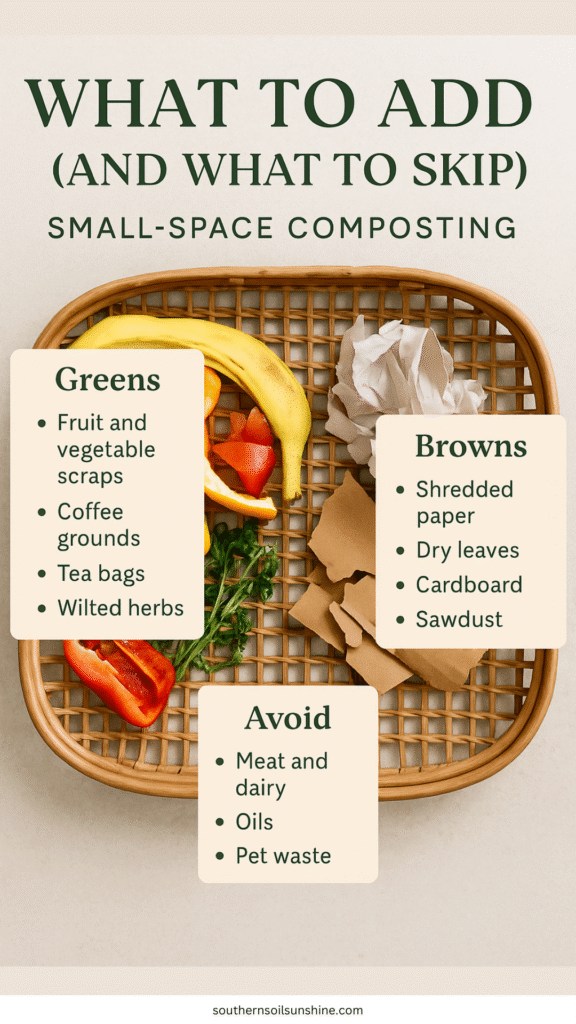
🍊 3. What to Add (and What to Skip)
Balance is the secret to composting. Without it, you end up with a smelly mess. With it, you create a sweet, earthy soil amendment.
Greens (Nitrogen-rich)
- Fruit and vegetable scraps
- Coffee grounds and filters
- Fresh grass clippings
- Herb stems, spent flowers
Browns (Carbon-rich)
- Shredded paper or cardboard
- Dry leaves
- Straw or sawdust
- Paper towels or napkins (plain, no chemical cleaners)
Avoid
- Meat, dairy, and oily foods (attract pests)
- Diseased plants
- Pet waste
Ratio Rule: Aim for 2 parts browns : 1 part greens in small bins. If things smell sour, add more browns. If nothing is breaking down, add more greens and a splash of water.
Think of it like a recipe—you’re creating balance, not perfection.
🪱 4. Managing Odor and Pests
This is the number one fear of apartment dwellers. The good news? Properly managed compost doesn’t stink.
- Aerate often: Stir or tumble to bring in oxygen.
- Layer wisely: Always cover wet food scraps with a dry brown layer.
- Seal tightly: Use lids on indoor bins.
- Freeze scraps first: I keep a freezer bag for scraps, then empty it into the compost weekly. No fruit flies, no mess.
Faith Connection: Just as our lives need breath and fresh perspective, compost needs oxygen. Neglect leads to stagnation. But with gentle stirring, renewal comes.
🌞 5. Seasonal Adjustments in Zone 9
Composting looks different depending on the season, especially here in Zone 9.
- Summer: Heat accelerates breakdown but dries material. Keep worm bins shaded and damp. Tumblers may need extra browns to offset wet scraps that turn slimy.
- Fall: Leaf drop is a gift! Bag some up to use as browns all year long.
- Winter: Slower decomposition, but worms stay active if sheltered. A garage can be a good winter home for bins.
- Spring: Surge of activity as temps rise. Perfect time to empty finished compost and refresh container soil.
Season by season, composting becomes a reflection of rhythm. God set the earth’s times in place: sowing, reaping, resting, renewing.
🌿 6. Troubleshooting Common Problems
Even small composting setups face challenges.
- Problem: Smells bad → Add more browns, stir, check moisture.
- Problem: Fruit flies → Freeze scraps or bury deeper under browns.
- Problem: Too dry → Mist lightly with water.
- Problem: Worms escaping → Bin is too wet, too hot, or lacking air. Adjust bedding.
Troubleshooting is not failure—it’s part of the learning process. Every gardener has a story of rescuing a bin gone wrong, and it becomes a badge of experience.
🌼 7. Creative Ways to Use Finished Compost
Once you’ve got finished compost, what do you do with it? Even in small spaces, it makes a difference.
- Top-dress potted plants: Sprinkle compost on the surface and water in.
- Mix into raised beds: Enrich soil at planting time.
- Compost tea: Steep a handful in water for a gentle liquid feed.
- Seed starting mix: Blend sifted compost with coco coir or perlite.
In one season, I used worm castings in my pepper pots. The difference was visible—lush, dark leaves and heavy fruit. Compost really is black gold.
🙏 8. Faith Lessons from Composting
Every time I open a bin and see scraps turning into soil, I feel a holy reminder: nothing is wasted.
- God takes what we think is useless and transforms it.
- Growth often happens in the hidden, messy places.
- Waiting is part of the process—compost takes months, not days.
Paul writes in 2 Corinthians 4:16, “Though outwardly we are wasting away, yet inwardly we are being renewed day by day.” Compost teaches us this truth.
📝 Journal Prompt ✍️
What “small scraps” in your life—things you’ve dismissed as waste or weakness—might God be transforming into nourishment for you and others?
🌿 Grace Note
Dear friend, remember: you don’t need a perfect system or a big yard to begin composting. All you need is willingness. Start with a jar, a bucket, or a bin. Let the soil remind you of God’s renewing work—He takes what is broken down and makes it beautiful again.
✨ Free Printable
👉 Download your Small-Space Composting Checklist to get started today. It includes:
- What to compost and what to avoid
- Setup steps for worm bins, bokashi, and tumblers
- A simple troubleshooting guide
(Link placeholder: you’ll provide Word + PDF versions)
🌻 Related Garden Wisdom
- Related: Harvesting Herbs: How and When
- Related: 5 Ways to Fix Blossom End Rot
- Related: How to Maximize a Small Garden in the Heat
- Related: Using Shade Cloth Without Smothering Your Plants
🎧 Podcast & 📖 eBook Mentions
For more encouragement, listen to The Rooted in Grace Podcast, where I share rhythms of soil and soul. And if you’d like to root your life in intuitive, grace-filled gardening, explore my eBook Rooted in Grace: A Christian Guide to Intuitive Gardening.
🍁 Final Thoughts
Starting composting in a small space may feel humble, even insignificant. But the Kingdom of God often begins small: a seed, a crumb, a prayer. Over time, those scraps of life become rich soil for growth.
I think back to the years when I hesitated because my space felt “too small.” Looking back, I see how those first steps—saving coffee grounds, layering newspaper, checking on worms with my children—were enough. More than enough.
The soil didn’t demand perfection; it welcomed faithfulness. And so does God.
So gather your peelings, your coffee grounds, your paper shreds. Trust the process. As you watch the cycle of breakdown and renewal, may you also remember that your own seasons of weariness can yield beauty in God’s timing. Composting is not just about soil—it’s about hope.


3 Comments