
Sowing the Summer Trio: Beans, Squash, and Cucumbers in Zone 9
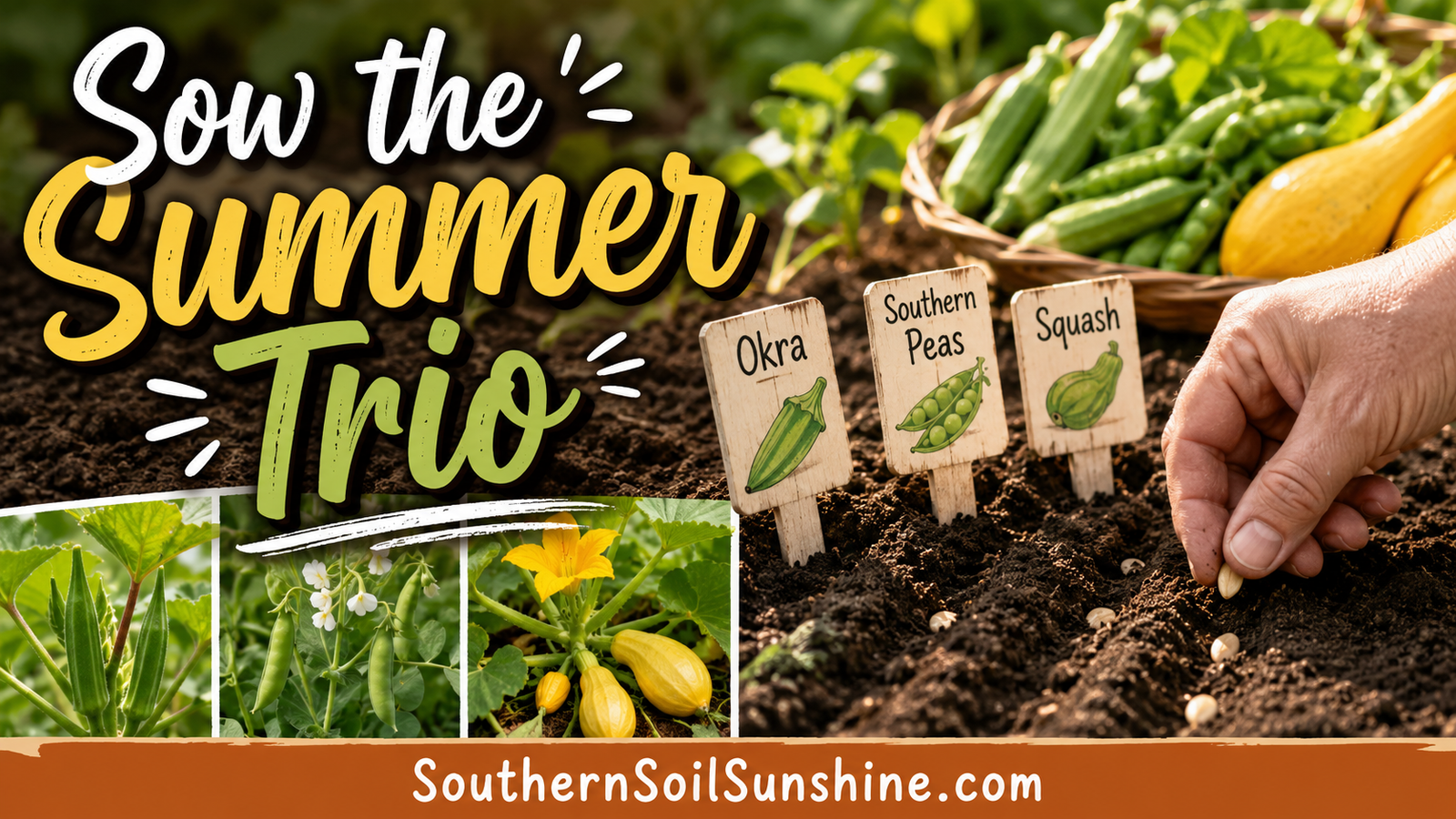
The Row That Becomes Summer 🌱
There are few gardening days more hopeful than the one when you sow the summer trio — beans, squash, and cucumbers — directly into warm April soil. These three crops are the heart of a Zone 9 summer garden: fast, generous, and so productive that a single short row can feed your family and half the neighborhood. Right now they are nothing but a handful of seeds in your palm. But sow them today into the warming ground, and by high summer this row will be overflowing — snap beans by the colander, zucchini you are giving away, cucumbers crisp off the vine. It is worth pausing, seeds in hand, to picture the abundance you are planting.
April is the sweet spot for direct-sowing all three in our climate. The soil has warmed enough for quick germination, and there is plenty of season ahead before the deep heat. Let me walk you through sowing the summer trio well, and why picturing the harvest is part of the planting.
Free eBook
Rooted in Grace
A Christian guide to intuitive gardening — the whole book, free. Tell me where to send it and it’s yours in a minute.
Why Direct-Sow These Three
Beans, squash, and cucumbers all share a trait that makes them perfect for direct sowing: they grow fast and they resent being transplanted. These are large-seeded, quick-germinating crops with sensitive roots that do best when planted right where they will grow. There is no need to fuss with seed trays and transplanting — simply tuck the seeds into prepared, warm soil, and they will be up in days. This is beginner-friendly gardening at its most rewarding: minimal effort, fast results, and enormous yields.
They also share a love of warmth. All three are warm-season crops that germinate poorly and grow slowly in cold soil, which is exactly why we wait until April, when the ground has warmed. Sown into soil that is ready for them, they leap out of the ground — often sprouting within four to seven days — and grow with a speed that keeps gardening exciting.
How to Sow Each One
Each of the trio has its own simple requirements. Here is a quick reference.
| Crop | Sow Depth | Spacing | Support? |
|---|---|---|---|
| Bush beans | 1 inch | 3–4 inches apart | No |
| Pole beans | 1 inch | 4–6 inches apart | Yes — trellis |
| Squash | 1 inch | 18–24 inches apart | Optional |
| Cucumbers | 1 inch | 12 inches apart | Yes — trellis is best |
Sow all three about an inch deep into loose, warm, compost-enriched soil, and water them in gently. Beans are the simplest — just space them along a row, and add a trellis first if you are growing pole types. Squash needs real room to sprawl, so give each plant plenty of space or a wide hill. Cucumbers do beautifully on a trellis, which keeps the fruit clean, straight, and easy to find, and saves precious garden space. Set your supports at sowing time so you are not disturbing roots later.
Caring for the Young Trio
Once your seeds are up, these crops are famously easy, but a little attention early pays off all summer. Keep the soil consistently moist while the seedlings establish, watering deeply at the base. Mulch around the young plants to hold moisture, suppress weeds, and keep the soil from baking. Watch for the pests that love these crops — cucumber beetles, squash bugs, and bean beetles — and catch them early while they are few; a light row cover over young plants keeps them off entirely until flowering, when you will remove it to let the bees in. Feed with a gentle compost tea as the plants grow, and give cucumbers and pole beans a hand finding their trellis.
Picture the Row Overflowing
This day’s task carries an invitation I love: picture this row overflowing with future meals and laughter. There is something quietly powerful about it. Right now you are looking at bare soil and a few buried seeds — nothing to see, nothing to show, just dirt and hope. But the gardener who can picture the harvest while planting the seed gardens with a joy that carries her through all the tending in between. She sees, in the empty row, the summer suppers, the full colanders, the kids eating beans straight off the vine, the abundance she will hand across the fence to a neighbor.
That imaginative hope is not naive; it is faith of the most practical kind. It is what makes the work of planting meaningful — we sow in the confident expectation of a harvest we cannot yet see. And this is how so much good in life gets planted: by people willing to picture the overflowing future while their hands are still in the empty, hopeful dirt of the beginning. The meals, the laughter, the shared abundance — all of it starts as a few small seeds and a vision held in the heart of the one doing the sowing. So as you tuck these seeds into the warm April soil, take a moment to truly picture it: the overflowing row, the full table, the laughter. You are not just planting beans and squash and cucumbers. You are planting a whole summer of nourishment and joy — and picturing it is part of how it grows.
Share your summer sowings with us on Instagram @southernsoils — there is such hope in a freshly planted row and the abundance it promises.
Choosing Varieties for a Zone 9 Summer
A little variety selection sets you up for success in our heat and humidity. For beans, both bush and pole types thrive here — bush beans give you a fast, concentrated harvest, while pole beans climb a trellis and produce over a longer stretch, which many Zone 9 gardeners prefer. For squash, the classic summer types like zucchini and yellow crookneck are wonderfully productive, though watch for squash vine borers, which are our region’s biggest squash challenge. For cucumbers, both slicing and pickling types do well, and disease-resistant varieties are worth seeking out in our humid air.
| Crop | Reliable Zone 9 Picks |
|---|---|
| Beans | Contender (bush), Rattlesnake & Kentucky Wonder (pole) |
| Squash | Zucchini, yellow crookneck, tromboncino (borer-resistant) |
| Cucumbers | Marketmore, Straight Eight, small picklers |
One insider tip for our climate: tromboncino, a vining Italian summer squash, resists the vine borers that devastate ordinary zucchini here, and it is wonderfully productive trained up a sturdy trellis. If squash vine borers have broken your heart in past summers, it is well worth a try. Choosing varieties suited to our particular challenges removes half the struggle before you ever open the seed packet.
Harvest Little and Often
Here is the secret that turns a good summer-trio planting into an overflowing one: harvest constantly. All three of these crops produce more the more you pick, and slow down or stop if you let fruit over-mature on the plant. Pick beans while they are young and tender, before the pods get lumpy and tough. Cut zucchini and summer squash small — six to eight inches is far more tender and flavorful than the baseball-bat monsters that hide under the leaves for a few extra days. Harvest cucumbers young and firm, before they yellow. Every fruit you pick signals the plant to make more, so frequent harvesting is not just about quality — it is how you keep the whole row producing at full tilt.
In peak summer, that can mean checking these plants every single day; squash especially can go from perfect to oversized in forty-eight hours. But this is a happy problem — it means your row is doing exactly what you pictured, overflowing faster than you can keep up. Keep a colander by the door, pick a little every day, and share the surplus freely. These crops were made for generosity.
A Whole Summer in a Handful of Seeds
It is worth marveling, before you head out to sow, at what you are actually holding. A handful of bean, squash, and cucumber seeds — a few cents’ worth of dry little things — contains an entire summer of food. Weeks of dinners, jars of pickles, beans for the freezer, more than one family can eat, all folded up in seeds small enough to fit in your palm. There are few clearer pictures of how abundance works: something almost nothing, planted in faith into warm and welcoming ground, multiplying into far more than you put in. Sow the summer trio today, picture the overflowing row it will become, and tend it toward the harvest with a glad and hopeful heart. The whole abundant summer begins right here, in this small, ordinary, faith-filled act of pressing seeds into the April soil.
The Joy of Growing More Than You Need
There is a particular gladness that comes with the summer trio, and it is the gladness of surplus. These are not stingy crops that give you a careful few. They pour out — more beans, more squash, more cucumbers than you planned for — and in doing so they teach a garden to be generous. The overflow becomes gifts: a bag of zucchini for a neighbor, cucumbers for a friend, beans shared at the table with laughter. That generosity is not an accident of these plants; it is their nature, and it can become yours. When you sow a row that will give more than you can keep, you are planting an invitation to share. So plant a little extra on purpose. Grow more than you need, and let the abundance spill over into other people’s kitchens and lives. The overflowing row is not just about feeding your family — it is about the quiet joy of having enough, and more than enough, to give away.
Ready to Go Deeper in the Garden?
If this article resonated with you, you might be ready for something more than tips.
- Download the FREE Rooted in Grace eBook
- Join Rooted Reset
- Follow on Instagram – @southernsoils
“The garden is not just a place to grow plants – it is a place to grow yourself.”
Free eBook
Before you go — the book is yours
Rooted in Grace: A Christian Guide to Intuitive Gardening. No cost, no catch. Read it on any device, at whatever pace the season allows.