Moving Tomato and Pepper Seedlings Outside: A Gentle 7-Day Hardening Plan
From the Sheltered Windowsill to the Open Garden 🌤️
Your tomato and pepper seedlings have spent their whole short lives in the gentlest possible world — steady warmth, soft light, no wind, no harsh sun, no cold nights. Now the day is coming to move them out into the real Zone 9 garden, where the sun is fierce, the breeze can whip, and February nights still turn chilly. If you take them straight from the windowsill to the open garden, the shock can stall them for weeks or even kill them outright. That transition needs to happen slowly. Gardeners call it hardening off, and it is one of the most important — and most overlooked — steps in growing your own transplants.
Think of it as teaching your plants to stand in stronger light a little at a time. Here is a simple week-long plan that works beautifully for our climate.
Free eBook
Rooted in Grace
A Christian guide to intuitive gardening — the whole book, free. Tell me where to send it and it’s yours in a minute.
Why You Cannot Skip This Step
Indoor seedlings have thin, tender leaves and soft stems that have never felt real wind or direct sun. Their surfaces are not yet built to handle intense light or fast-moving air, and they have never had to hold moisture against a drying breeze. Move them out too fast and the leaves scorch white, the stems snap, and the plant pours all its energy into damage control instead of growth. Hardening off gives them time to thicken their leaves, toughen their stems, and adjust their internal chemistry so they can thrive outside.
It helps to remember what you are really doing here. You are not testing your plants to see if they are strong enough. You are making them strong enough, one gentle exposure at a time.
The 7-Day Hardening Schedule
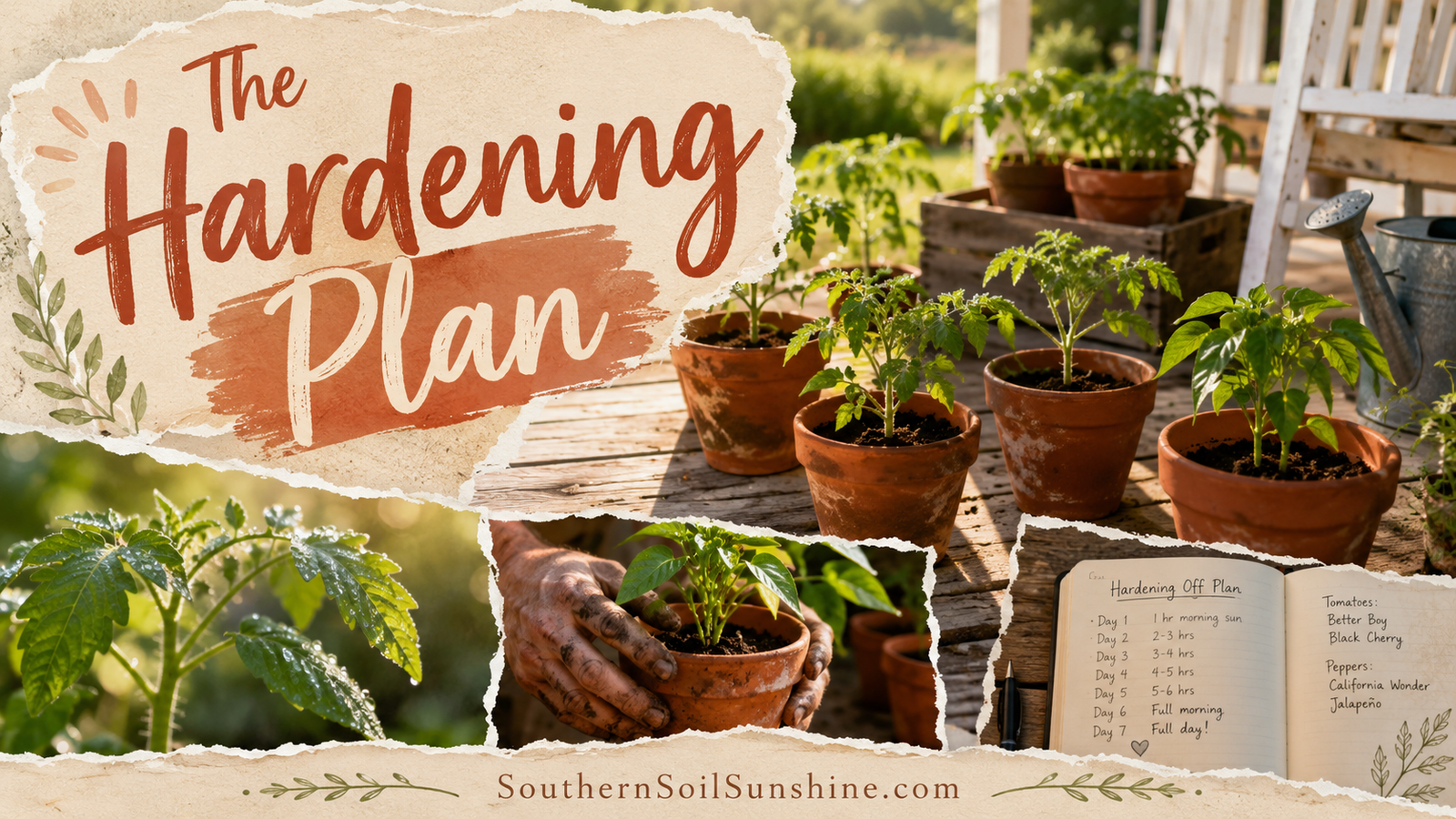
Start on a mild, not-too-sunny day, and increase exposure gradually. Bring the seedlings back in each night at first, then leave them out as the nights warm.
| Day | Time Outside | Location | Notes |
|---|---|---|---|
| 1–2 | 1–2 hours | Shade, sheltered from wind | Morning is gentlest |
| 3–4 | 3–4 hours | Filtered sun, light breeze | Watch for wilting |
| 5–6 | Most of the day | A few hours of direct sun | Bring in if below 50°F |
| 7 | All day + overnight | Full sun, garden spot | If nights are mild, leave out |
Go at the plants’ pace, not the calendar’s. If a leaf looks scorched or a plant wilts hard, pull back a step and give it an easier day tomorrow. Keep the soil evenly moist through this week — plants outdoors dry out much faster than they did inside, and a hardening seedling that also gets drought-stressed is being asked to bear too much at once.
The Most Common Hardening-Off Mistakes
Give them this full week. I know it is tempting, when the plants look ready and you are eager for the season to start, to just set them all out and be done. But the week you invest in hardening off is repaid many times over in stronger, faster-growing plants that never miss a beat after transplant. A rushed transplant can sulk for two or three weeks; a well-hardened one keeps right on growing.
A Simple Way to Remember It
If the table feels like a lot to track, hold onto one idea: a little more each day, with retreat still allowed. More time, more sun, more wind — added in small increments, with the option to come back to shelter whenever it is too much. Follow that instinct and you will not go far wrong, even if your exact hours never match the chart.
Being Stretched Into New Light
There is a reason this day pairs hardening off with noticing where you are being gently stretched into new light. Growth almost always requires leaving the sheltered place. But notice how the garden does it — not by throwing the tender thing into full intensity all at once, but by increasing exposure slowly, with retreat still available, until what was fragile becomes strong enough to stand in the open.
That is a kinder model of growth than the one we often use on ourselves. If you are being stretched right now — into a new role, a harder season, a brighter and more exposed place than you are used to — you do not have to do it all in one day. You are allowed to step out a little, come back to shelter, and step out a little further tomorrow. Strength built gradually is the strength that lasts.
Take your seedlings out for their first hour today. And maybe take yourself one gentle step toward the new light, too.
Tag us in your hardening-off setups on Instagram @southernsoils — from windowsills to sunny porches, we love seeing plants take their first steps outside.
Setting Up an Easy Hardening-Off Station
You do not need anything fancy to harden off well — just a plan for where the plants will sit and how you will move them. The simplest setup is a shady, wind-sheltered spot near your door where you can set the trays out in the morning and see them easily, so you actually remember to bring them in. A porch with a roof, the east side of the house that gets gentle morning sun, or a spot beneath a patio table all work beautifully for those first days.
A few small comforts make the week smoother. Put your trays on a wagon or a wheeled cart if you have one, so moving them in and out is a two-minute job instead of a chore you dread. Group the seedlings close together — they shelter one another from wind that way. And set a phone reminder for “bring plants in” the first few evenings, because the single most common way to lose a tray is simply forgetting it outside on a cold night.
Reading Your Plants Through the Week
Your seedlings will tell you clearly how the transition is going if you watch them. A little afternoon wilting that recovers by evening is normal and even useful — it is the plant learning to manage water in moving air. But white or tan scorched patches on the leaves mean too much direct sun too soon, and a snapped or badly bent stem means the wind was more than the plant was ready for. Purpling leaves often mean the plant got too cold. When you see any of these, simply step back to an easier level for a day or two, then resume. You are not behind schedule; you are listening, which is exactly what good hardening off requires.
| What You See | What It Means | What to Do |
|---|---|---|
| Slight midday wilt, recovers by evening | Normal adjustment | Continue as planned |
| White/tan scorched patches | Too much sun too soon | Back to shade a day or two |
| Bent or snapped stems | Wind exposure too fast | Return to a sheltered spot |
| Purple-tinged leaves | Got too cold | Bring in on cold nights |
Transplant Day: Sending Them Off Well
Once your seedlings have completed their week and can handle a full day and night outside, you are ready to plant them into the garden — and a good transplant day protects everything you just built. Choose a mild, overcast afternoon or the cool of evening rather than blazing midday sun, so the plants settle in without heat stress on their first day in the ground. Water the seedlings before you plant and water the bed after, tucking each one in with a gentle firming of soil around the roots. For tomatoes especially, you can plant deeper than they grew in the pot — those tiny hairs along the buried stem will become new roots, giving you a stronger plant. Then give them a few days of easy attention while they root in.
The Kindness of Gradual
I return often to what hardening off models about growth, because our culture is so quick to admire the opposite. We celebrate the leap, the plunge, the all-at-once. But the garden grows its strongest plants by a gentler math: a little more exposure each day, with retreat still allowed, until what was fragile can stand in the open sun and thrive. Nothing is thrown into the deep end. Everything is stretched, and then given rest, and then stretched a little further.
If you carry one thing from this small task into the rest of your life, let it be that. You are allowed to grow at the pace of a hardening seedling. You can step into the new light for an hour, come back to shelter, and step out a little further tomorrow. That is not weakness or slowness. It is the very design by which tender things become strong enough to bear fruit.
What If the Weather Won’t Cooperate?
February in our part of Zone 9 rarely gives you a tidy, matching week of mild days — and that is fine. Hardening off is forgiving as long as you keep the principle and let go of the exact schedule. If a cold front stalls your progress, simply pause: keep the seedlings inside or bring them in at night, and pick up where you left off once it passes. There is no harm in a hardening week that stretches to ten days because the weather made you wait. If a stretch turns unusually hot and bright, lean on shade — a bit of shade cloth, a patio umbrella, or the dappled light under a tree buys you time on the sunniest afternoons. The plants are not counting days. They are simply responding to what they have felt so far, and you are free to give them easier or harder conditions as the sky allows. Watch the plants, watch the forecast, and trust your eyes over any calendar. That flexibility — holding the goal firmly and the timeline loosely — is the mark of a gardener who has done this a few seasons, and it is a peace worth growing into.
Ready to Go Deeper in the Garden?
If this article resonated with you, you might be ready for something more than tips.
- Download the FREE Rooted in Grace eBook
- Join Rooted Reset
- Follow on Instagram – @southernsoils
“The garden is not just a place to grow plants – it is a place to grow yourself.”
Free eBook
Before you go — the book is yours
Rooted in Grace: A Christian Guide to Intuitive Gardening. No cost, no catch. Read it on any device, at whatever pace the season allows.